










On Tuesday, the largest U.S. trade association celebrated another year—its 118th to be exact—of preserving, protecting and advancing the right to real estate.
The association has come a long way since 120 men gathered at a Young Men’s Christian Association (YMCA) hall in Chicago on May 12, 1908, with a vision “to unite the real estate men of America.”
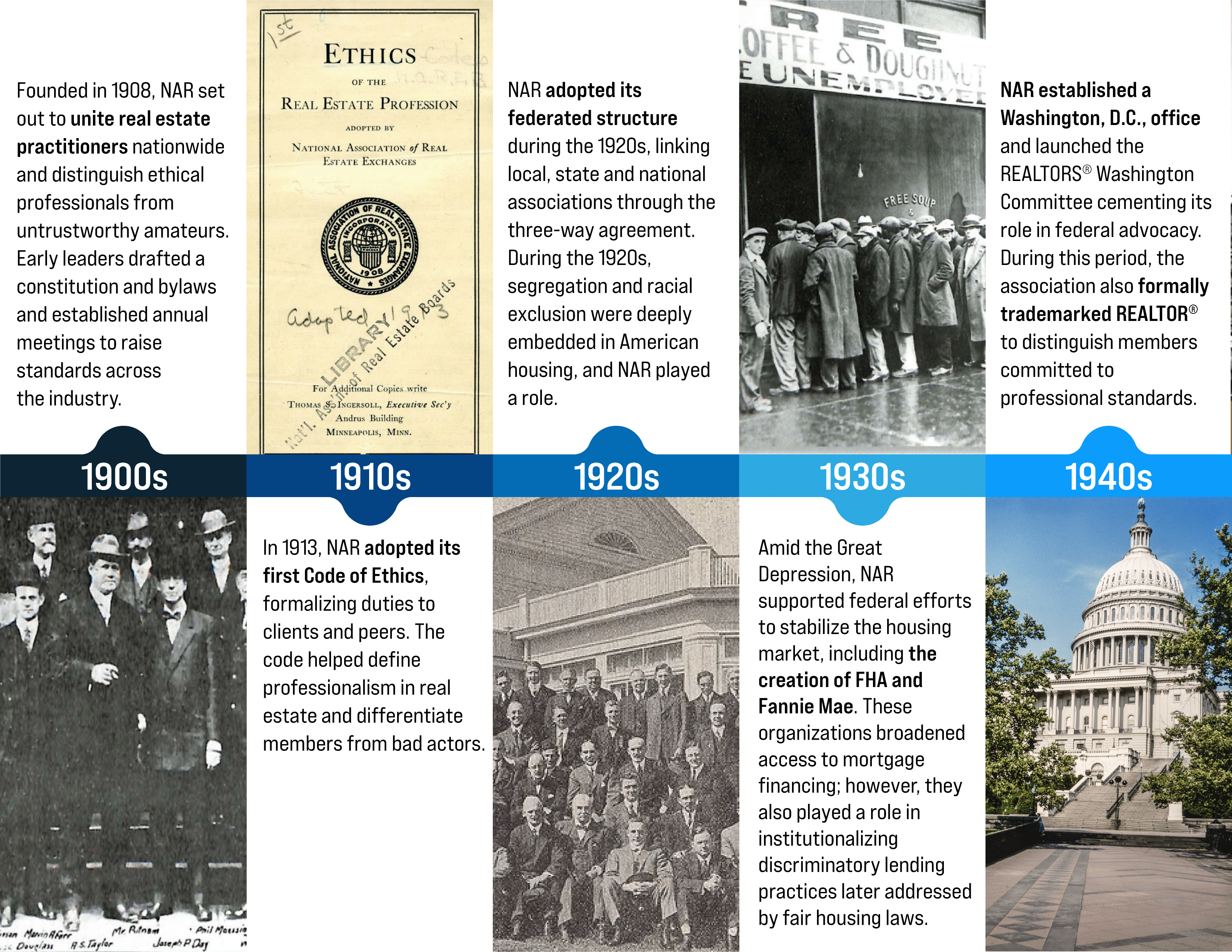
Tapping into NAR’s centennial publication and Library & Archives, here’s a brief look at some of NAR’s milestones and contributions to the industry throughout the decades, many of which continue to this day.
1900s: Real Estate Professionalized
Historians point to the late 1800s as the beginning of organized real estate, with local boards popping up in major cities like Chicago, Cincinnati and New York, and state boards popping up in the early 1900s.
NAR was founded in 1908 as the National Association of Real Estate Exchanges, and its earliest leaders set out to distinguish ethical practitioners from untrustworthy amateurs, known then as “curbstoners,” by establishing professional standards.
When 120 delegates from 20 local and state boards met on May 12, 1908, they outlined their objective to raise the bar of professionalism and drafted the association’s constitution and bylaws. The group established an annual meeting, seen as a rare opportunity for entrepreneurs from around the country to discuss emergent issues concerning the industry.
1910s: Code of Ethics
In 1913, the organization adopted its first Code of Ethics to codify standards, articulate duties to clients and peers and differentiate members from bad actors. Adopted at the organization’s annual conference held that year in Manitoba, Canada, the code spelled out 23 duties to clients—being “absolutely honest, truthful, faithful and efficient” among them—and other brokers.
NAR Timeline 1900s-1940s
1920s: Local, State and National Associations Work in Harmony
The 1920s saw the adoption of the organization’s federated structure of local, state and national associations, known colloquially as the three-way agreement. The arrangement equalized access of services for all members.
During this decade, the association recognized practitioners’ desire to specialize in various real estate fields and set up several divisions, many of which would go on to become affiliated organizations. Those divisions served as brokers, property managers, farmland specialists, industrial property specialists, appraisers and home builders.
The 1920s was also a time of great segregation and racial exclusion from mainstream economic opportunities in the U.S., and NAR played a role. As African American and immigrants poured into industrial cities looking for work, they faced discrimination and exclusion in employment and housing. In 1924, NAR introduced an article in its Code of Ethics stating: “A Realtor should never be instrumental in introducing into a neighborhood a character of property or occupancy, members of any race or nationality, or any individual whose presence will clearly be detrimental to property values of that neighborhood.”
Although NAR revised and renumbered the code in 1950, and removed the references to race and nationality, “many [members] continued to understand Article 33 as having a racial intent,” said Damian Da Costa, writing for NAR’s centennial book, “100 Years in Celebration of the American Dream.”
1930s: Making Loans More Accessible
NAR also played an active role in debates about economic recovery following the Great Depression. It advocated for the formation of the Federal Housing Administration, which Congress established in 1934 in response to stagnation in the market and widespread foreclosures. The agency was designed to revive homeownership by insuring bank mortgages, thereby expanding access to financing and making homeownership attainable for a broader segment of the population.
NAR also pushed for the creation of the Federal National Mortgage Association, known today as Fannie Mae.
While these organizations were instrumental in building a strong base of homeowners in the U.S., they also played a role in institutionalizing discriminatory lending practices in the decades leading to the passage of the Fair Housing Act and other fair lending laws.
1940s: Solidifying Its Advocacy Presence and Trademark
In 1942, NAR established a Washington, D.C., office and formed the REALTORS® Washington Committee, solidifying its Capitol Hill presence. It was originally devised as a way to assist the country’s World War II efforts; however, members of the committee frequently met with federal officials on issues concerning other matters, including rent control and gas rationing. Today, NAR is widely recognized as having one of the most effective lobbying organizations in the country.
NAR members also trademarked a title they had been using for decades. The word “Realtor” was coined by Minneapolis broker Charles Chadbourn in 1915 as a way to distinguish members from “rascals” of the time.
In “A Nation of Realtors,” Jeffrey Hornstein chronicles Chadbourn’s epiphany after reading about a fake real estate agent who swindled money from a widow:
“‘Why should not Real Estate Board members adopt some name by which to call themselves, which would distinguish themselves from such rascals? Why could we not adopt a title [that] would designate our members, would imply that we are vouched for by our Board as well as qualified and responsible and would confirm the confidence of the public in them?’”
Between 1947 and 1950, NAR filed applications and ultimately registered its collective membership marks REALTORS® and REALTOR® with the U.S. Patent and Trademark Office.
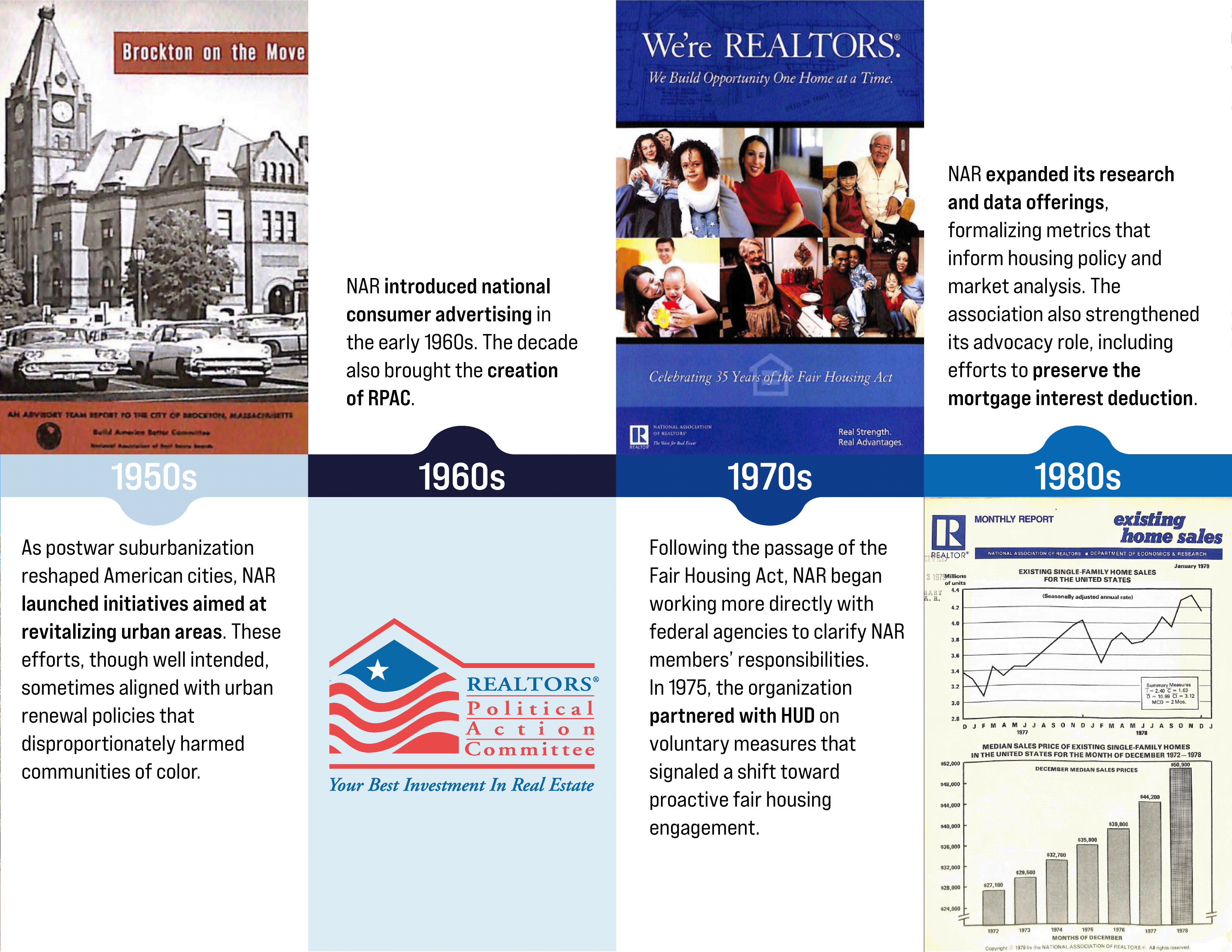
1950: Urban Renewal
Following World War II, as many Americans flocked to newly built suburbs, NAR saw an opportunity to help blighted cities. In 1952 it launched a Build America Better Committee, where advisory groups traveled to cities across the country, making customized recommendations that included rehabbing existing houses, transportation, zoning laws and more. While the work of these advisory groups was often well-intentioned, much like the lending practices of the 20th century, the consequences were not always positive.
Writers like Richard Rothstein, author of “The Color of Law”, have documented how policies dubbed as “urban renewal” or “slum clearance” often resulted in razing communities of color to make way for the development of highways and more profitable land uses.
NAR Timeline 1950s-1980s
1960s: Consumer Advertising, National Flood Insurance and RPAC
The association launched its first national advertisement, taking out a full-page ad in “U.S. News & World Report” in 1962. Readers were encouraged to “look for the REALTOR® seal.”
The late 60s also saw the creation of the REALTORS® Political Action Committee (RPAC). From its start, the organization was considered bipartisan, supporting both Democratic and Republican candidates who championed NAR positions.
Thanks to NAR’s federated structure, the PAC also enabled NAR members to make an impact on state-level politics. “All funds collected were split—as they are today—between national and state REALTOR® associations, enabling REALTORS® to support like-minded candidates at all levels of government,” reads the book, “100 Years in Celebration of The American Dream.”
1970s: Fair Housing
For several years after the passage of the Fair Housing Act in 1968, which NAR had officially opposed, many NAR leaders remained at odds with the U.S. Department of Housing & Urban Development’s proposed rules for implementing the law. That changed in 1975 when NAR joined HUD to adopt the Voluntary Affirmative Marketing Agreement (VAMA). The agreement clarified NAR members’ responsibilities under fair housing law and signaling a shift toward proactive engagement on equal housing opportunity.
1980s: Becoming “The Voice for Real Estate”
During this period, NAR expanded its role as a data provider, introducing its Housing Affordability Index and formalizing Existing-Home Sales (EHS) research metrics. (EHS kicked off in January 1966, with 120 local boards participating.) In 1989, the board unanimously approved The Voice for Real Estate as NAR’s unifying theme.
The association’s lobbying efforts provided a crucial consumer benefit with the preservation of the mortgage interest deduction, which was on the chopping block during tax reform proposals.
1990s: Realtor.com and Limiting Bank Power
The rise of the internet reshaped real estate marketing and information access.
In a 1993 speech, NAR President Bill Chee urged the board of directors to act quickly to innovate and create consumer-facing listing products before tech companies swooped in:
“Consumer trends are driving the market to provide more and more services and more and more access, while NAR’s MLS systems are positioned at the opposite end of this trend by having outmoded technology. By making the MLS an exclusionary database, we are not only running counter to the habits and expectations of the consuming public, we are opening vast opportunities to emerging ‘lions.’ If you believe, as I do, that the hungry lion is coming over the hill, the big question is. What do we do?”
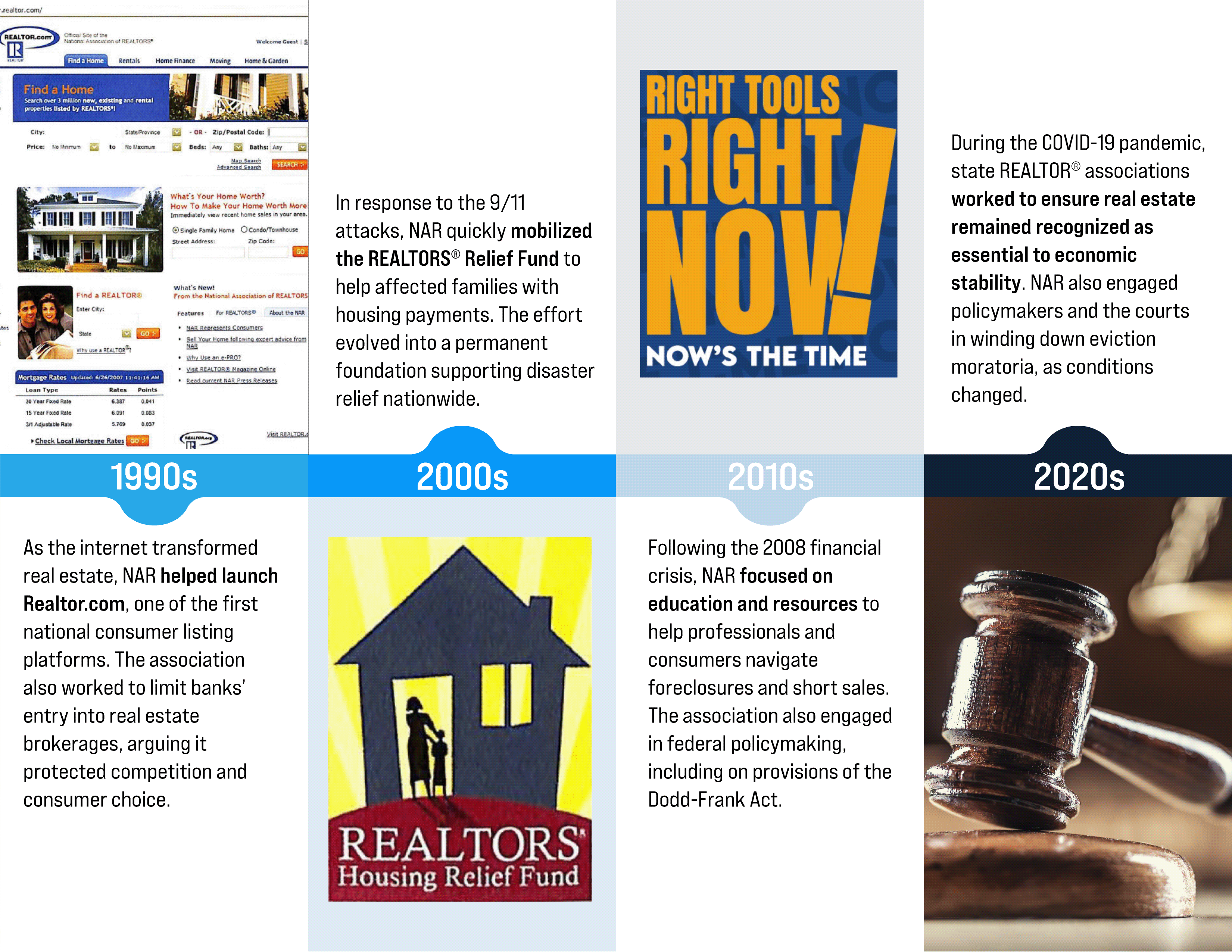
Chee’s speech galvanized NAR leaders and led to the launch of Realtor.com, one of the first national consumer real estate platforms. The site was launched through a partnership with a private company known as Homestore. (Today, Realtor.com is owned and operated by NewsCorp.)
Another significant development involved federally chartered banks. NAR actively lobbied Congress to draw a clear line between banking and real estate brokerages, a move to protect consumer choice and competition. In 1991, Congress approved legislation limiting the powers of federally chartered banks and rolled back existing authority of state-chartered banks.
The battle resurfaced in the new millennium with the passage of the Gramm-Leach-Bliley Act of 1999. The bill removed barriers put in place during the Great Depression that separated banking, securities and insurance. NAR fought successfully for nine years to keep large, national banks out of real estate brokerage and management, arguing that real estate is a commercial rather than a financial enterprise and that opening that door would undermine the important safeguards put in place to prevent another depression. For nearly a decade NAR achieved congressional moratoriums on funding the rulemaking that would have allowed banks to expand into real estate services. In 2009, NAR achieved a permanent victory—a ban on banks entering the real estate brokerage and management business—with the Omnibus Appropriations Act of that year.
NAR Timeline 1990s-2020s
2000s: REALTORS® Relief Foundation
Within hours of the tragic 9/11 terror attack, the association mobilized and established the REALTORS® Relief Foundation to help victims’ families with mortgage and rent payments. NAR leaders provided an initial seed donation of $1 million from the association’s reserves, and REALTOR® agents delivered checks within days.
“I delivered checks to the wives of five victims,” George Naylor Jr., a member from Southampton, Pa., said in 2002. “It was the first assistance they received, and it meant a lot. One was already behind in her mortgage payments. I don’t know if we [the real estate industry] got much notice for what we did, and I don’t know that we should. In our hearts we know we did the right thing.”
More than $8.4 million poured in to provide housing-related assistance and funds were raised and distributed within 100 days. The fund was transitioned into the REALTORS® Relief Foundation, which continues to aid victims of disasters across the country.
2010s: Showing Up After the Crash
In the early 2010s, NAR focused heavily on helping REALTORS® and consumers navigate the aftermath of the 2008 financial crisis, when foreclosures, underwater mortgages and short sales dominated many markets. In 2009, NAR launched its Short Sales and Foreclosure Resource (SFR®) certification course and offered no-cost resources and education through its Right Tools, Right Now program.
NAR was also instrumental in shaping the federal government’s response, including working with Congress on provisions of the Dodd-Frank Wall Street Reform and Consumer Protection Act that tightened mortgage lending standards and strengthened consumer protections, while seeking to ensure the law did not unduly burden REALTORS®.
2020s: Making Real Estate Possible During COVID
During the COVID‑19 pandemic, while many businesses ground to halt, state REALTOR® associations fought to make sure real estate professionals’ livelihoods weren’t threatened. They helped ensure members were designated as essential workers in many jurisdictions, underscoring housing’s central role in economic stability.
Additionally, NAR engaged policymakers and the courts in winding down eviction moratoria, which threatened property owners’ bottom lines, as conditions changed.
The early 2020s also marked a period of intense scrutiny and antitrust litigation targeting the residential real estate industry. While the results of that litigation, including financial settlements and practice changes, are still being sorted out, throughout the process, NAR has worked to preserve consumers’ ability to benefit from the services of a real estate professional, protect individual members from liability and communicate the value REALTORS® bring to the transaction.
So What’s Next?
The association continues to build on the foundations laid over the last 118 years, while continuing to evolve. An organization founded exclusively for white men, now represents a membership that’s majority female, and with both females and people of diverse background serving as leaders.
NAR’s Executive Committee passed a three-year Strategic Plan in November 2025 designed to accomplish two priorities: build the future member experience and modernize the association.
“Our organization has been serving REALTORS® for more than a century, and I see this Strategic Plan as the first three years of our next 100 years of business,” 2026 NAR President Kevin Brown recently said. “We’re helping our members navigate the issues that impact their day-to-day business, like financing, inventory, insurance, zoning restrictions and other barriers to home and property ownership. It means leveling up areas that members already find valuable, such as our advocacy, research and tech tools. And it means finding new ways to help our members get to, and execute, their next transaction.”
The ultimate goal is to help members of NAR continue unlocking the American dream, for many, many years to come.