Quick Takeaways
- The Qualified Opportunity Zone (QOZ) program was created in 2017 to encourage economic growth in low income communities, as identified by the US Census Bureau.
- In July 2025 the program was reauthorized and made permanent, with some changes. The “QOZ 2.0” program will be effective January 1, 2027.
- Qualified Opportunity Zones offer tax benefits, including the exclusion of capital tax gains when investments are made through an Opportunity Fund.
- The original QOZ program is set to fully sunset on December 31, 2047.
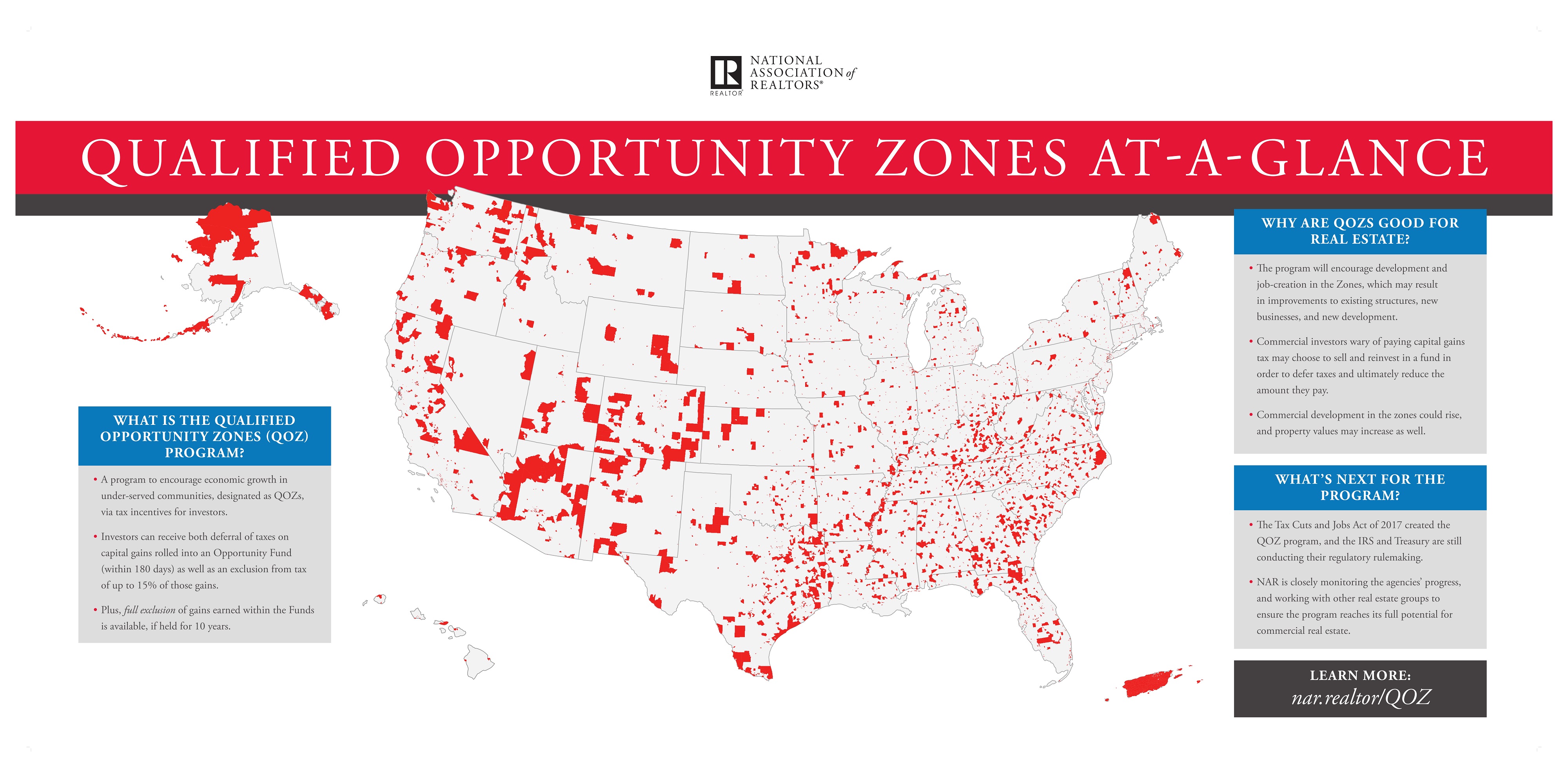
The Qualified Opportunity Zone (“QOZ”) program was created by the 2017 Tax Cuts and Jobs Act to encourage economic growth in underserved communities through tax incentives for investors who utilize “Opportunity Funds” to invest in the zones. Along with tax benefits, it presents opportunities for real estate investment and development in those communities. U.S states and territories, including Washington, D.C., nominated areas to be designated as QOZs in 2018, and the IRS and Treasury finalized the designations that year. In July 2025, the program was reauthorized and made permanent with updated rules. The original iteration of the program will sunset on December 31, 2047, while the 2.0 program will go into effect on January 1, 2027.
The Original QOZ Program (Passed in 2017 and Sunsetting on December 31, 2027)
There are multiple tax benefits available to investors who invest in a QOZ, provided all requirements are met. First, capital gains reinvested within 180 days into a QOZ can be deferred until as late as 2026, for up to nine years. In addition, if the new investment is held for at least five years, the taxable gain is reduced by 10%; if held for seven years, the reduction increases to 15%. In addition, gains accrued on investments in a QOZ are free of capital gains tax if they are held for at least ten years. These investments must be processed through an “Opportunity Fund,” which is a partnership or a corporation organized for the purpose of investing in QOZ property; these funds are self-certified, and must hold at least 90% of their assets in a QOZ property (which includes stock, partnership interests, and/or tangible property used in a trade or business in a QOZ, such as real estate).
QOZ “2.0” Program (Passed in 2025 and Effective January 1, 2027)
The reauthorized and permanent program introduces several changes from the original version. Beginning July 1, 2026, states may nominate census tracts for designation as zones under the new program. To qualify, a tract must have an area median income at or below 70% of the state or metropolitan average, or a poverty rate of at least 20%, and a median family income no greater than 125% of the area median. Governors will be able to redesignate zones every ten years, and a minimum of 25% must be rural. Investors who invest their capital gains into a Qualified Opportunity fund are eligible for a 10% basis step-up after a 5-year holding period, but the higher basis step up of 15% after 7 years in the original program is eliminated. A rolling 30-year deferral cap applies to investments. As in the original program, tax on new gains from QOZ investments are eliminated if they’re held for 10 years. Reporting requirements for QOZs under the 2.0 program are also higher, and there are significant penalties for noncompliance.
A major change is the creation of Qualified Rural Opportunity Zones and Funds. A rural zone is defined as any area other than a city or town that has 50,000 or more in population and any urbanized area contiguous or adjacent to such a city or town. A Qualified Rural Opportunity Fund must hold at least 90% of its assets in QOZ property located substantially within a QOZ composed entirely of rural areas, or in QOZ stock or partnership interests in a QOZ business whose tangible property is substantially all located in a QOZ that is entirely rural. The benefits for investing in a rural QOZ are higher as well—while non-rural zones must meet a 100% substantial improvement test, rural zones only have a 50% substantial improvement test.
Qualified Opportunity Zone 2.0 Update
See References for more information.