


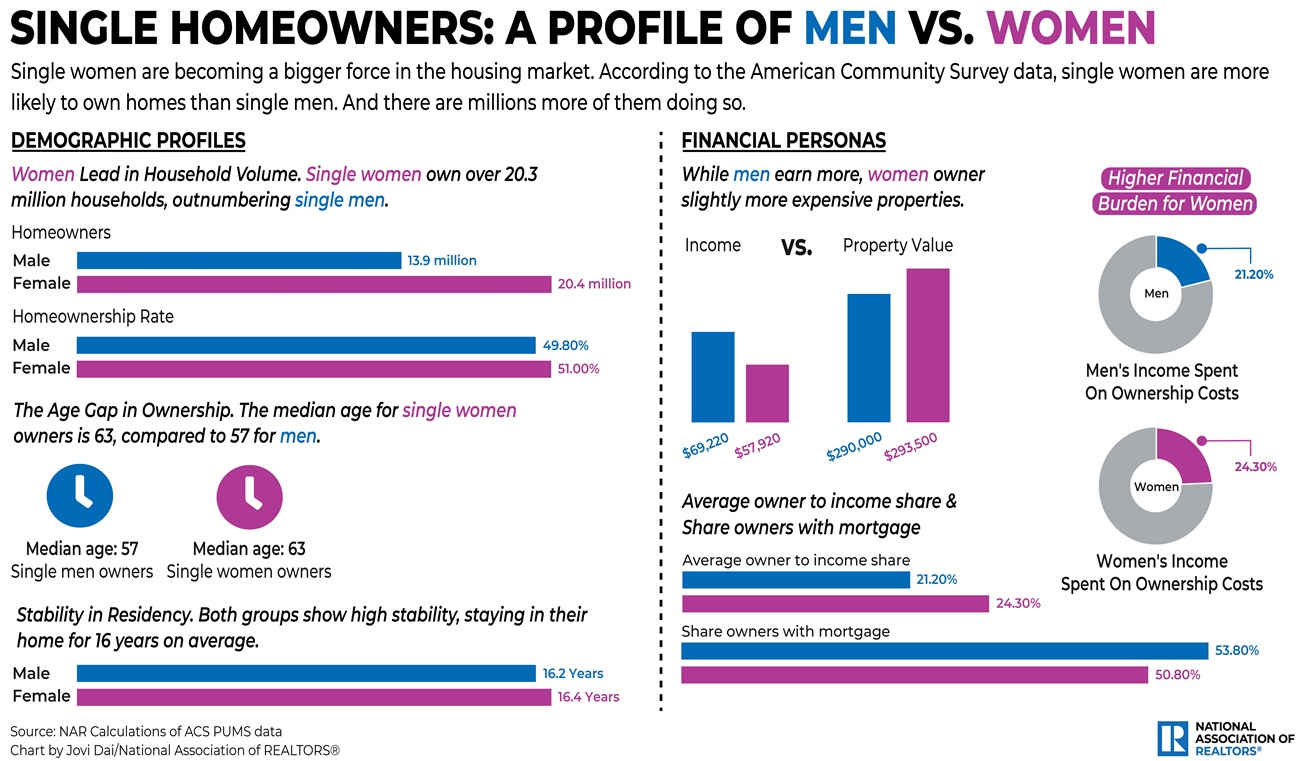
Click image to see full graph without scrolling.
Please note: The data visualization embeds on this page are best viewed on a laptop or desktop computer.
Single women are becoming a bigger force in the housing market. According to the American Community Survey data, single women are more likely to own homes than single men. And there are millions more of them continuing to enter the market. But what’s more interesting than the headline number is the story behind it: who these homeowners are, how they got there, and where this trend is strongest.
At the national level, about 51% of single women own their homes, compared with just under 50% of single men. It’s not a huge difference, but it adds up. There are more than 20 million single women homeowners, far more than about 14 million single men.
Contributing to the recent increase in homeownership among single women are those who are divorced, separated, or never married. Over the past decade, homeownership rates among divorced women rose from 55% to 60%, and among separated women from 33% to 39%. Even among never-married women, rates increased from 30% to 34%. These gains suggest that more women are entering the housing market on their own.
At the same time, widowed women remain the most likely to own homes, with a homeownership rate of about 73%. But of course, this reflects something different—not a new entry into the market; rather, someone who is maintaining long-term housing stability.

As a result, single women homeowners tend to be older. The median age is about 63, compared with 57 for single men. They also tend to stay in their homes longer, about 18 years compared to 16 years on average for single men. And that extra time allows them to build equity and benefit from rising home values.
At younger ages, single men are still more likely to own homes. But over time, that gap narrows—and in some cases reverses. Among women under 35, homeownership rates have increased significantly over the past decade. For example, among those aged 25 to 34, rates rose from 20% in 2014 to 25% in 2024. For those 35 to 44, rates increased from 36% to 40%. At older ages, homeownership is much more common. Nearly 70% of women aged 65 and older own their homes, reflecting years of staying in the market and building wealth. In other words, the data show that for many women, homeownership occurs later but lasts longer.

The median income for single women homeowners is about $58,000, compared with $69,000 for single men. In other words, single women earn about 84 cents for every dollar single men earn. But despite that, single women are still more likely to own.
In the meantime, data shows that single women are more financially stretched. On average, single women homeowners spend about 30% of their income on housing, compared with 26% for men. At the same time, they are slightly less likely to have a mortgage. About 51% of single women homeowners have a mortgage, compared with 54% of men. This reflects the fact that many women have owned their homes longer and have paid down more of their debt. And, that longer tenure translates into more housing equity. For an average home valued at around $300,000, after 18 years, homeowners have typically paid off close to 45% of their mortgage, turning time into equity. Over that same period, home prices have almost doubled, adding more than $140,000 in value. Combined with years of paying down the mortgage, many single women homeowners have built over $200,000 in total housing equity.
But the national numbers don’t tell the full story.
When you zoom in locally, the pattern becomes much more visible and much more uneven. In 57% of metro areas, single women have a higher homeownership rate than single men. And in some markets, the gap is not small.

Markets like Vallejo, California; McAllen, Texas; Asheville, North Carolina; Davenport, Iowa; and Palm Bay and Naples in Florida stand out for having some of the widest differences. In these metros, single women are significantly more likely to own homes than their male counterparts.
What’s striking is that this trend shows up even in some of the most expensive housing markets in the country. In San Jose, San Francisco, Seattle, and Los Angeles, where homeownership rates are generally below 50%, single women are still more likely to own homes than single men. Even where affordability is most challenging, women are finding ways to stay in the market.
At the same time, some markets have experienced the fastest gains in homeownership among single women. Many of the biggest increases over the past decade are concentrated in Florida, especially in Palm Bay and Cape Coral, as well as in markets like Mobile, Alabama; Stockton, California; Spartanburg, South Carolina; and Las Vegas, Nevada. These are areas where home prices, while rising, are still more aligned with local incomes, making it easier to enter the market.
Overall, the data points to something bigger than a demographic trend. In some markets, single women are already ahead. In others, they are catching up quickly. And across much of the country, they are becoming a larger and more stable part of the homeowner base. This isn’t just about income or affordability. It’s also about timing, persistence, and staying power in the housing market.
Because in the end, homeownership isn’t only about who can buy, it’s also about who can stay. And increasingly, that story includes more single women than ever before.

Nadia Evangelou is principal economist and director of real estate research for the National Association of REALTORS®.