


Click image to view full graph without scrolling
Please note: The data visualization embeds on this page are best viewed on a laptop or desktop computer.
When we talk about housing demand, we often focus on prices, mortgage rates, or inventory. But all of those outcomes start somewhere much earlier — with household formation.
Household formation happens when young adults move out on their own, families grow, shared households split, or older adults choose to live independently for longer. Each of those decisions creates housing demand, even if overall population growth itself is modest.
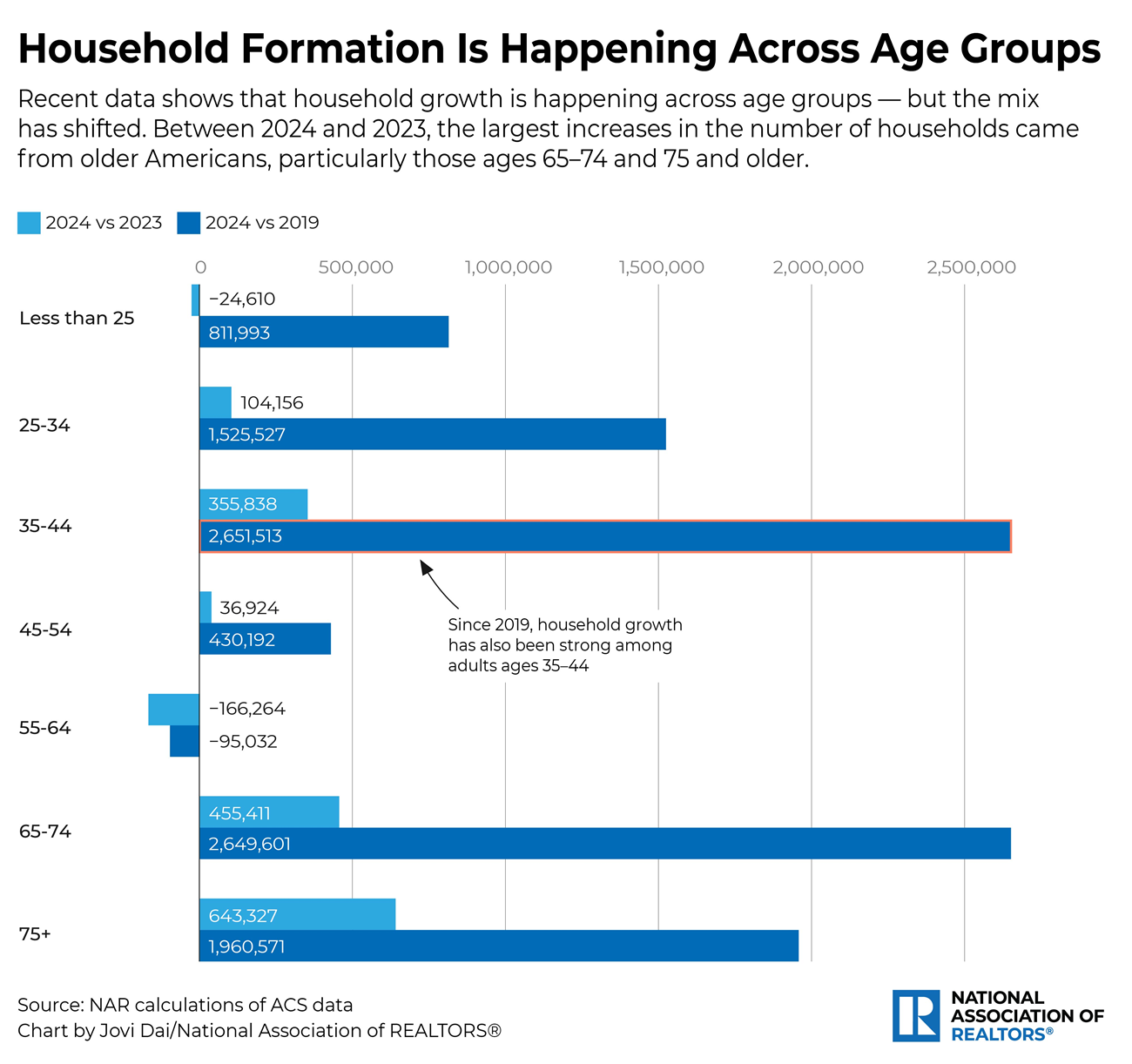
Recent data shows that household growth is happening across age groups, but the mix has shifted. Between 2024 and 2023, the largest gains came from older Americans, especially those ages 65–74 and 75 and older. Longer lifespans, better health, and a strong preference to age in place are all contributing to more households forming at older ages.
At the same time, looking back over the past five years tells a broader story. Since 2019, household growth among adults ages 35–44 has also been strong, reflecting continued family formation and life-stage changes. In other words, housing demand isn’t being driven by just one generation. It’s being shaped at both ends of the age spectrum.
For the housing market, this matters. Household formation helps explain why demand can remain elevated even when sales slow or population growth cools. People are still forming households — they’re just doing so in different ways and at different stages of life.
For REALTORS®, this is an important reminder about housing demand. Younger households may be focused on space, schools, and stability. Older households may be thinking about accessibility, downsizing, or staying put. Understanding who is forming households — and how that has changed — provides valuable context for today’s housing market.

Nadia Evangelou is principal economist and director of real estate research for the National Association of REALTORS®.