Click image to see full graph without scrolling.
Please note: The data visualization embeds on this page are best viewed on a laptop or desktop computer.
Sustainability is gaining attention in commercial real estate, but its impact on value and market performance is still evolving. While more work remains to educate the market on the benefits of green features, data from NAR’s 2025 Commercial Sustainability Report suggests encouraging trends. Perceptions around green certifications, the promotion of energy-efficient features in property listings, the time those buildings spend on the market, and which features clients find important all offer useful signals about how sustainability can give a competitive market advantage.
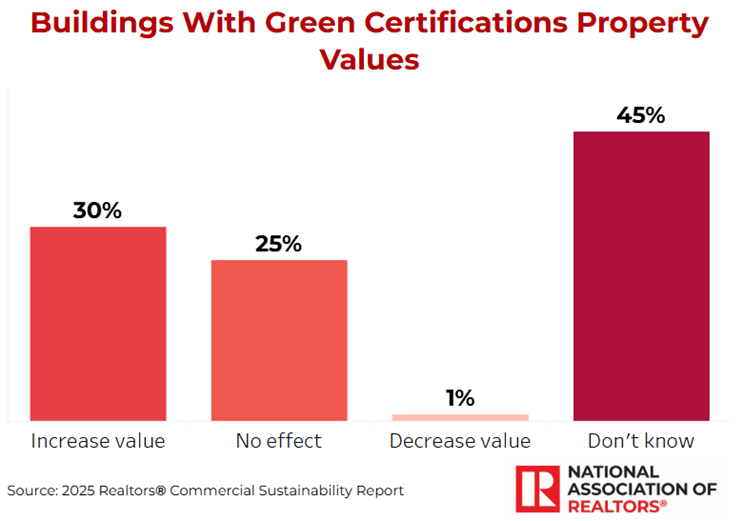
Thirty percent of REALTORS® report that green certifications, such as LEED and Energy Star, increase the property values of commercial buildings in their markets, indicating that sustainability features are beginning to translate into measurable financial benefits. This perception is strongest in the Midwest and South, where 32% of respondents in each region report an expected increase in value. The West follows closely at 31%, while the Northeast shows a slightly lower but still substantial share of 26%. This growing recognition suggests that investors and tenants alike are placing greater emphasis on environmentally responsible assets, often perceiving them as lower risk, higher quality options. As awareness expands, green certifications may play an even larger role in helping properties differentiate themselves, particularly in competitive markets where buyers prioritize long term operating efficiency, cost control amid rising energy and utility expenses, and regulatory preparedness.
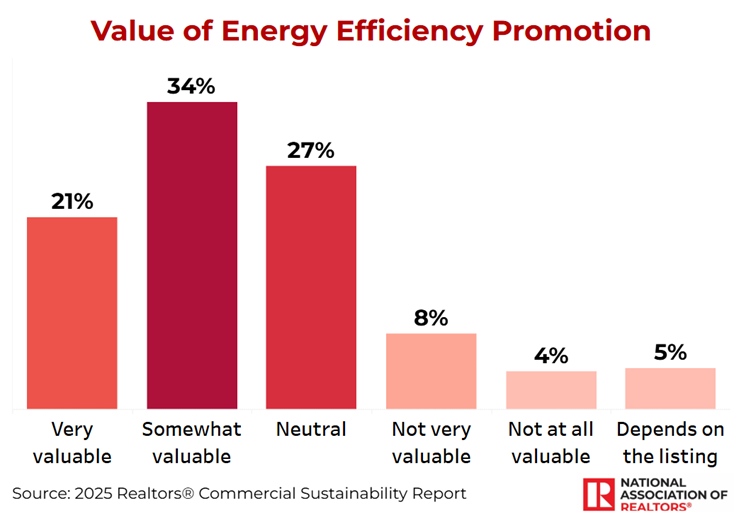
Agents and brokers are also seeing the value of actively promoting sustainability features, with more than half (55%) of REALTORS® saying that highlighting energy efficiency in listings is valuable. Regionally, the pattern is consistent across the United States, with 58% in the Northeast, 54% in the Midwest, 56% in the South, and 56% in the West. This indicates that, nationwide, sustainability messaging is becoming a recognized selling point in commercial real estate. By showcasing details such as energy‑efficient systems, insulation upgrades, or smart building technologies, real estate professionals are able to position properties as more desirable by highlighting both operational benefits and the potential for meaningful cost savings amid rising energy and utility expenses.
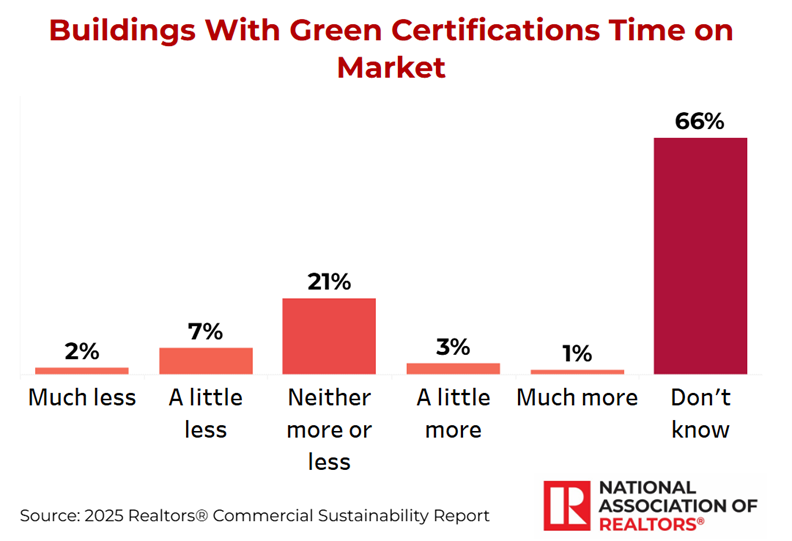
Market performance indicators further support the idea that sustainability can influence activity levels. Nine percent of REALTORS® report that green-certified buildings spend less time on the market, suggesting that these features may appeal to a subset of buyers actively seeking them out. At the same time, more than one in five (21 percent) say that certifications have no measurable impact on days on market, underscoring that the commercial sector is still in transition. As familiarity with and education about sustainability grow and more data become available, the industry will be better equipped to understand how green features influence market velocity across different property types and regions.
According to REALTORS®, utility and operations costs stand out as the top priority among prospective tenants, with a combined 70% of respondents rating them as either very (32%) or somewhat important (38%). This view is especially pronounced in the Northeast, where 41% of respondents said that utility and operations costs are very important to clients. Indoor air quality and energy efficient windows and doors follow closely, each viewed as important by more than 60% of respondents. Concerns about extreme weather events, such as drought, heat, and flooding, also rank highly, reflecting growing awareness of climate-related risks. In the South, 45% of respondents said that impact of extreme weather is very (22%) or somewhat important (23%) to clients.

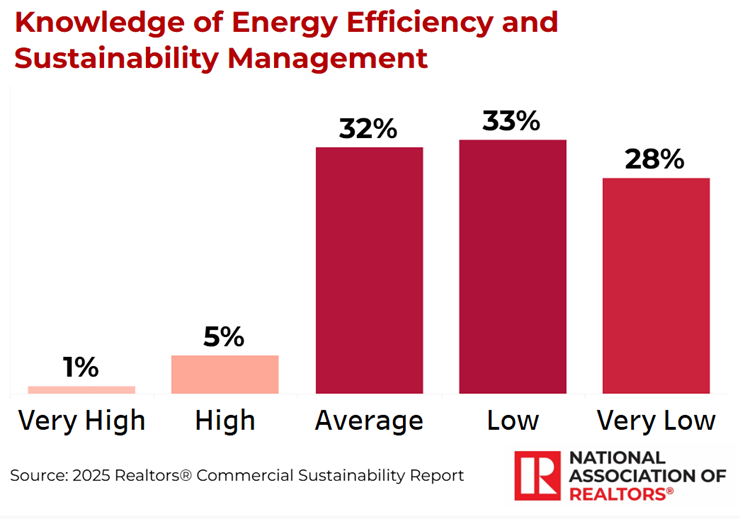
The data also makes clear that the path forward hinges on expanding industry knowledge. With three in five commercial professionals rating their understanding of energy efficiency and sustainability as low (33%) or very low (28%), there’s a significant education gap that must be closed to fully realize the value of green investments. But this gap also represents opportunity: as practitioners deepen their expertise, they’ll be better equipped to guide clients, highlight meaningful building features, and interpret sustainability metrics with confidence. For those interested in learning more about issues of energy efficiency and sustainability in real estate, consider looking into NAR’s GREEN Designation.