


A surge in data center development capable of powering the AI boom is unfolding across the country, bringing massive facilities—with often their demanding energy and water needs—closer to residential communities. That’s raising a new question for home buyers and homeowners: What’s the impact of living near a data center?
The National Association of REALTORS®, which maintains no official policy position on data centers, is taking a closer look at the growth in its newly released report, “2026 Data Center Impact,” which measures data centers up against county-level performance in home values, employment, electricity costs and more, as well as survey feedback from real estate agents.
Overall, “there is no single data center effect,” says Lawrence Yun, NAR’s chief economist. “Instead, the story varies significantly depending on the local market. … We do not see evidence of weaker housing markets in counties with a large data center presence. But these are county-level numbers, and they can’t tell us what happens to an individual home next to a facility. That’s why local knowledge and credible data matter so much right now.”
What the Data Shows on Data Centers
The growth in data centers has been capturing more news headlines, but a closer look at the data reveals only a small concentration of markets are experiencing significant growth. Although data centers are now found across much of the country, NAR’s analysis shows that 92% of more than 3,200 U.S. counties tracked have no mapped data centers at all. Only 1% have 10 or more.
Growth appears to be clustered in limited areas, led by Northern Virginia, notably Loudoun, Prince William and Fairfax counties, which comprise about 21% of data centers nationally. Other hubs emerging for data centers include Silicon Valley (5%); central Ohio, particularly Franklin and Licking counties (5%); the Phoenix area (4%); and central Washington (4%).
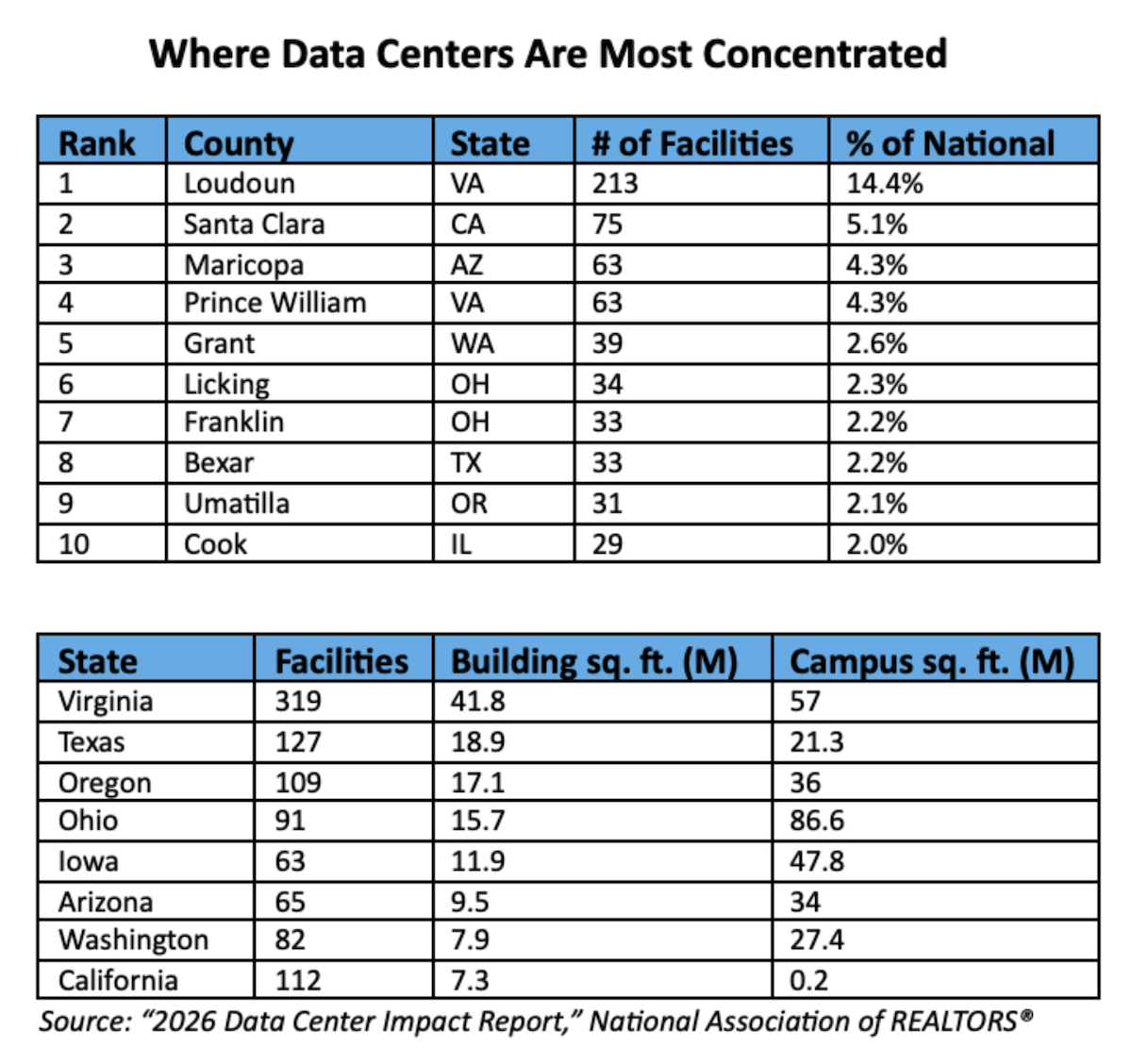
NAR’s analysis found that data centers tend to be in higher-cost housing markets that have strong long-term housing appreciation and job growth. For example, the median home value in counties with no data centers is $174,500, whereas in counties with 10 or more data centers, the median home value is $431,750.
But “higher home values or faster price appreciation do not necessarily mean that data centers caused home values to increase,” the report says. “In fact, many of the country’s largest data center markets were already very different from the typical county. Some are large metropolitan areas with strong technology and professional sectors, while others offer power, land or infrastructure that has helped attract data center investment.”
Data Center Impact: What Real Estate Pros Are Finding
Anecdotally, real estate pros are mixed on the impact data centers have when they come to town: 25% of agents surveyed say they see a positive effect on nearby home values, 22% perceive a negative impact and about one-third of respondents were unsure. Sixteen percent of real estate agents said they thought data centers led to at least a 5% increase in nearby property values, whereas 11% thought their presence prompted a 5% decrease to values.
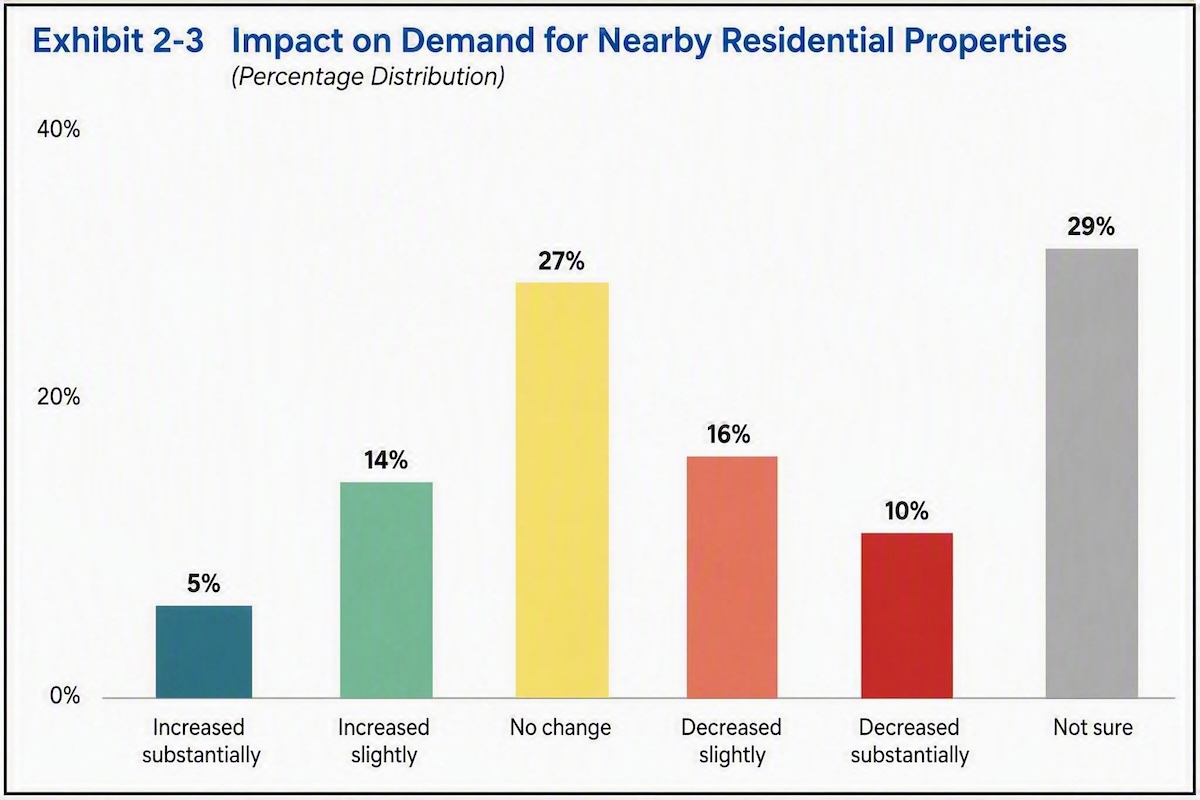
Real estate pros also were mixed on how the presence of data centers affected demand for residential properties near them: 26% said it decreased demand, 27% said it had no change, and 19% reported an increase in demand.
One of the main concerns about having data centers nearby has been over its demand for electricity and, depending on the facility’s cooling system, water usage. The NAR analysis did find an uptick for residential electricity rates—with rates climbing 21.4% from 2020 to 2024 in counties with 10 or more data centers compared with a 15.7% uptick in rates for counties without data centers. But researchers note that the rates did not consistently rise as the number of data centers increased, and electricity rate data is measured on a state (not county) level, which could be skewing its impact.
Overall, real estate pros report the top concerns expressed among their clients from nearby data centers were due to:
- Energy costs: 61%
- Water use of the data center: 56%
- Perceived environmental contamination: 43%
- Impact on the immediate landscape: 32%
Meanwhile, real estate professionals viewed the impact of data centers on nearby commercial properties as much more favorable. Fifty percent of agents surveyed by NAR reported an increase in commercial property values in proximity to data centers, and 42% reported an uptick in demand for nearby commercial space, particularly industrial properties and land. About 22% of agents reported having a nearby data center prompted commercial property values to increase by more than 10%.
“Data centers are increasing industrial land and commercial property values as they attract economic development, infrastructure investment and related businesses,” the report notes, based on agents’ feedback.
Learn More About Your Data Center Neighbor
Realtor.com projects that more than 2% of U.S. home sales will take place within five miles of an active large data center by the end of 2027—more than double the share in 2018. So far, Realtor.com’s own analysis has found no measurable difference in home sale or listing prices after large data centers recently opened compared with similar communities.
Still, buyers may want to investigate factors such as noise, water use, power infrastructure, utility costs and future expansion before deciding whether they’re comfortable with a property near a data center.
For Melissa Bailey, a sales team lead at Real Broker in Phoenix, the issue hit close to home when a data center was built in a commercial area behind her home. She researched how the city was addressing concerns, including water use, and found it had added a water reclamation site capable of processing millions of gallons of reclaimed water each month to offset demand. That helped ease her concerns about any potential impact on the city’s drinking-water supply.
“Everybody has an opinion on data centers, and whatever their opinion is, that’s fine,” Bailey says. But if ones coming near you, she advises, “research what your municipality is doing to mitigate concerns because they could have plans in place that minimize any adverse impact.”
