


More buyers entered into contracts for a home in May, the latest sign that the housing market could be on the mend after four sluggish years for home sales.
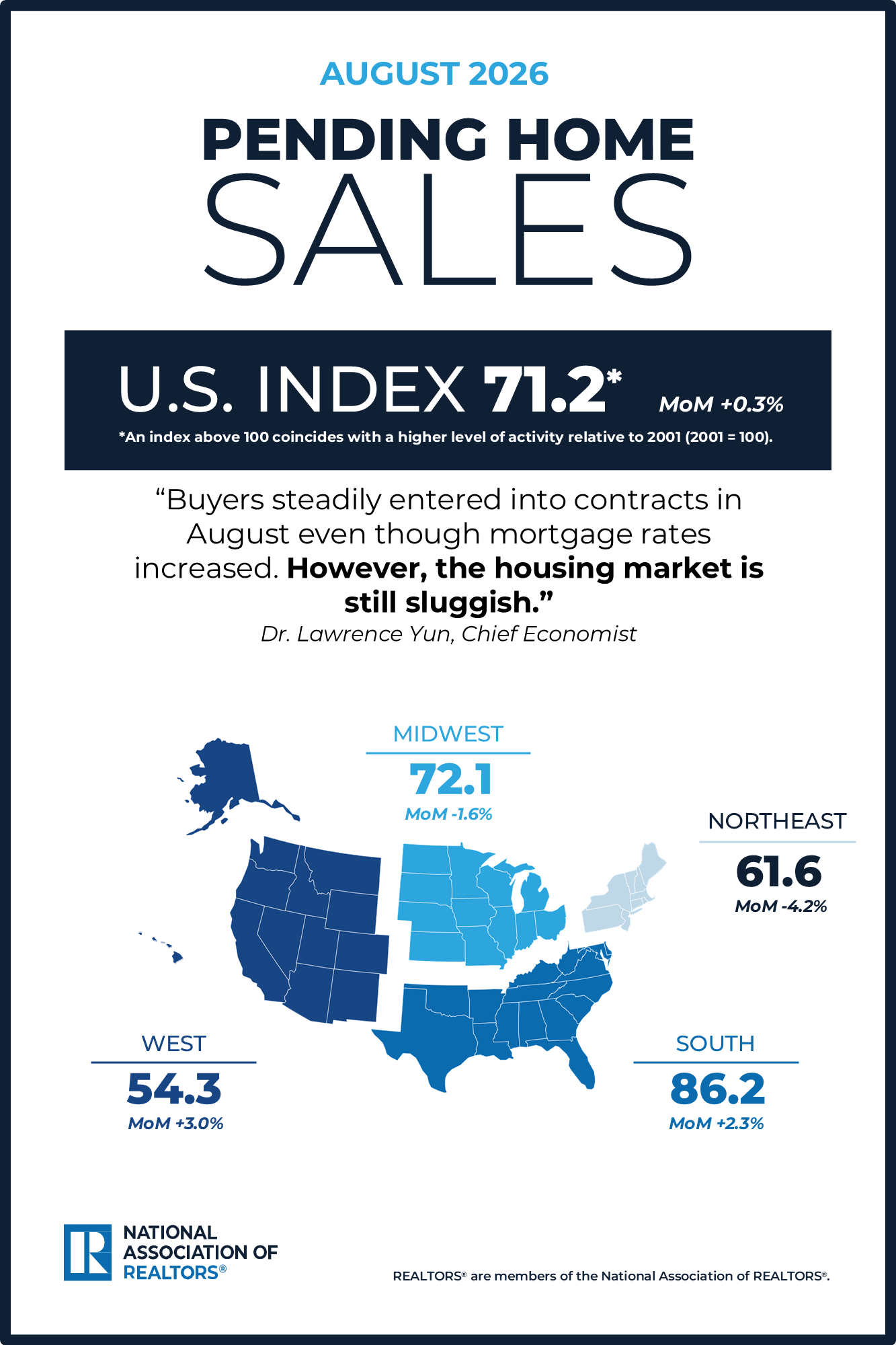
The National Association of REALTORS®’ Pending Home Sales Index showed contract signings—a gauge of future home sales—rose 3.8% last month compared to April and were up nearly 5% from a year ago. All four major regions across the U.S. saw an uptick in pending home sales, led by 8% monthly increases in the Northeast and Midwest. NAR also reported last week that existing-home sales—which reflects closed sales—saw a 3.2% increase, marking one of the best figures for sales data in the past three years.
“A late-spring buyer rush—even with mortgage rates not budging—is an indication of pent-up housing demand and consumers’ acceptance of above-6% mortgage rates as the new normal,” says NAR’s Chief Economist Lawrence Yun. The 30-year fixed-rate mortgage has been averaging in the mid-6% range over recent weeks.
Buyers could even see a slight reprieve in rates: “Going forward, falling oil prices will help lower mortgage rates,” says Yun, although he added that any rate declines likely would be modest.
Related: ‘More Americans Are on the Move,’ Latest NAR Sales Data Shows
Market Acceptance
Home buyers are readjusting their budgets as they also contend with higher home prices. NAR reported last week that the median existing-home price for all housing types climbed to $429,300, the highest ever recorded for the month of May. However, that represented a 1.3% annual increase, which actually signaled a cooling in home price growth compared to prior years.
A limited number of homes for sale remains a key driver of home price growth in many markets. But buyers may be better positioned to absorb those increases. Income and wages have been rising at roughly a 3% to 4% annual pace, helping to offset higher prices.
For example, “the inventory-constrained Northeast region, which has seen faster home price growth but slower home sales for several months, is now showing more buyer contract signings,” Yun says, noting the region saw an 8.7% monthly increase in pending home sales and a 6.1% annual gain. Still, “more supply is needed to help moderate home price growth,” he says.
Yun noted at a press conference last week that housing inventories would need to rise about 30% to meaningfully ease conditions for home buyers.
10 Markets Seeing the Strongest Surge in Pending Home Sales
The Midwest led in existing-home sales monthly gains in May, up 6.4%. The trend will likely continue given the region also saw pending home sales rise 8.1% last month. The region continues to offer some of the nation’s most affordable home prices at a median of $336,300.
Several Midwest markets were among the metros posting double-digit yearly increases in contract signings this spring. Realtor.com® Economics notes the following markets posted the largest annual increases in pending home sales in May:
- Kansas City, Mo.-Kan.: +20.1%
- San Antonio-New Braunfels, Texas: +15.7%
- Minneapolis-St. Paul-Bloomington, Minn.-Wis.: +13.9%
- Miami-Fort Lauderdale-West Palm Beach, Fla.: +11.4%
- Louisville/Jefferson County, Ky.-Ind.: +11.2%
- Cincinnati, Ohio-Ky.-Ind.: +10.1%
- Nashville-Davidson-Murfreesboro-Franklin, Tenn.: +9.4%
- Milwaukee-Waukesha, Wis.: +8.7%
- Virginia Beach-Chesapeake-Norfolk, Va.-N.C.: +8.2%
- Richmond, Va.: +8.2%
