


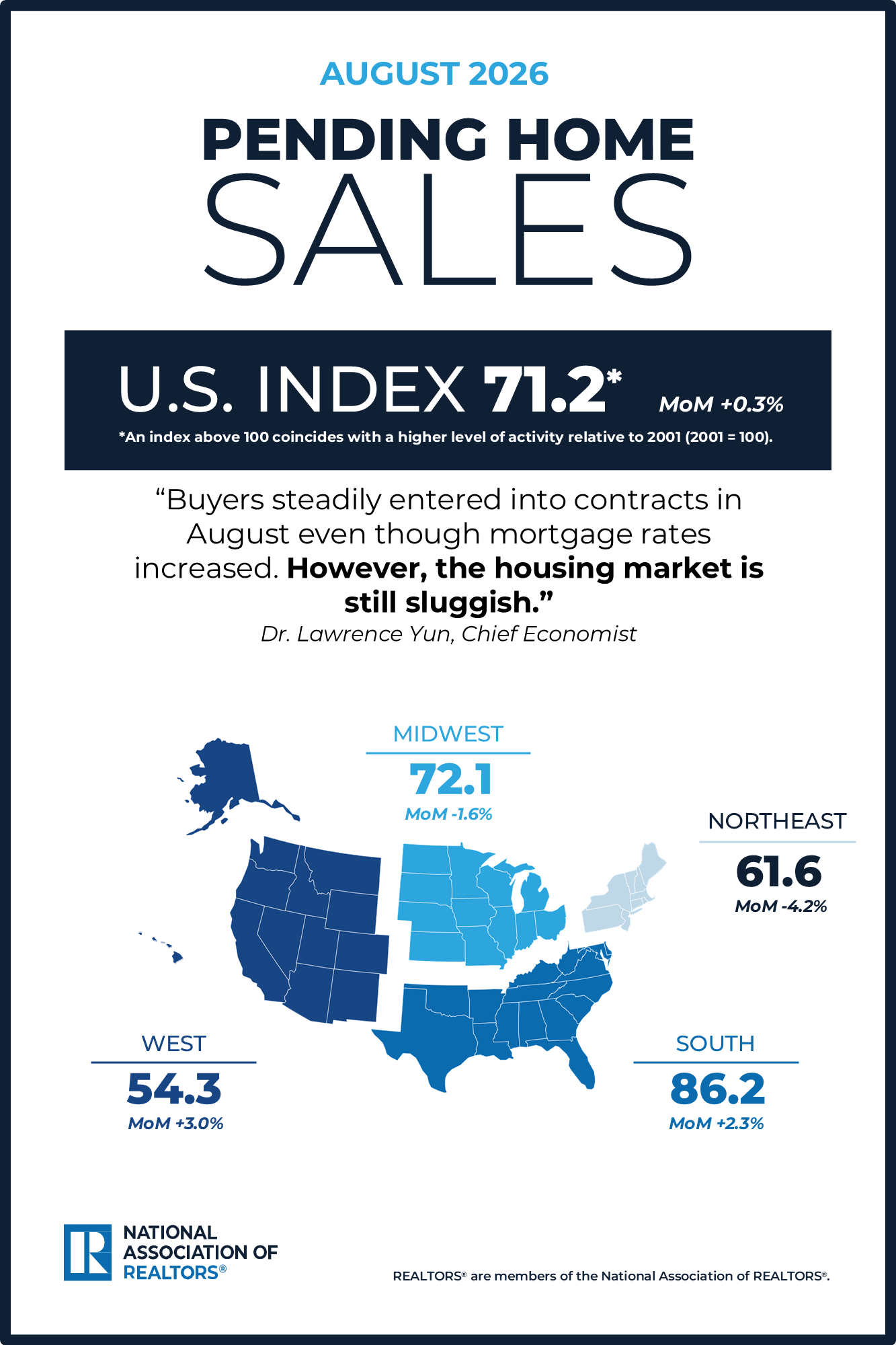
Higher mortgage rates aren’t stopping home buyers altogether, but they aren’t exactly causing them to rush in either. Contract signings in August held fairly steady, nudging up 0.3% from July. Still, pending home sales remain 4.7% below a year ago, according to the National Association of REALTORS®’ newly released Pending Home Sales Index, a gauge of future home sales based on contract signings.
Still, “buyers steadily entered into contracts in August even though mortgage rates increased,” says Lawrence Yun, NAR’s chief economist. “However, the housing market is still sluggish with contract signings below last year. This is due to higher mortgage rates offsetting the increased buying power created by job gains and income growth outpacing home price growth.”
Home prices are still rising, too. NAR reports the median existing-home sales price in August rose 1.6% annually to $429,100.
Nationally, pending home sales in August continue to run about 30% below their pre-pandemic 2019 levels, Yun adds.
But differences are showing up geographically, with activity varying widely from one market to another. NAR’s Pending Home Sales Index showed monthly gains in August in the South and West, up 2.3% and 3%, respectively, but fell 4.2% in the Northeast and 1.6% in the Midwest.
“The Northeast and the Midwest saw the fastest home-price growth in August, which is part of the reason that those same two regions posted the steepest declines in contract signings,” Yun says. Prices in August rose 4.3% annually to $556,900 in the Northeast and 3.3% to $340,400 in the Midwest, which remained the most affordable region in the country.
Those regional differences are part of a broader pattern of uneven housing activity across the country. “We’re in a really interesting spot in the housing market in the U.S. where typically the entire market is either moving in one direction or the other,” says Michael Perna, CEO of the Perna Team real estate agency in Detroit. “But now we’ve got 50 different metros with 50 different markets happening.”
There’s one thing these markets have in common: They’re ultra-focused on mortgage rates at the moment.
Related: After a Cooler Summer Market, Will Sales Pick Up for Fall?
Higher Mortgage Rates Spark Concerns
For home buyers and sellers, the path of mortgage rates could be one of the biggest factors to watch as the market heads into the fall. The 30-year fixed-rate mortgage remained elevated in August, averaging 6.67%, but made a more dramatic turn last week, surpassing 7%. The Mortgage News Daily reported the 30-year fixed-rate climbed to 7.22% on Sept. 15, with rates now about a full percentage point higher than a year ago.
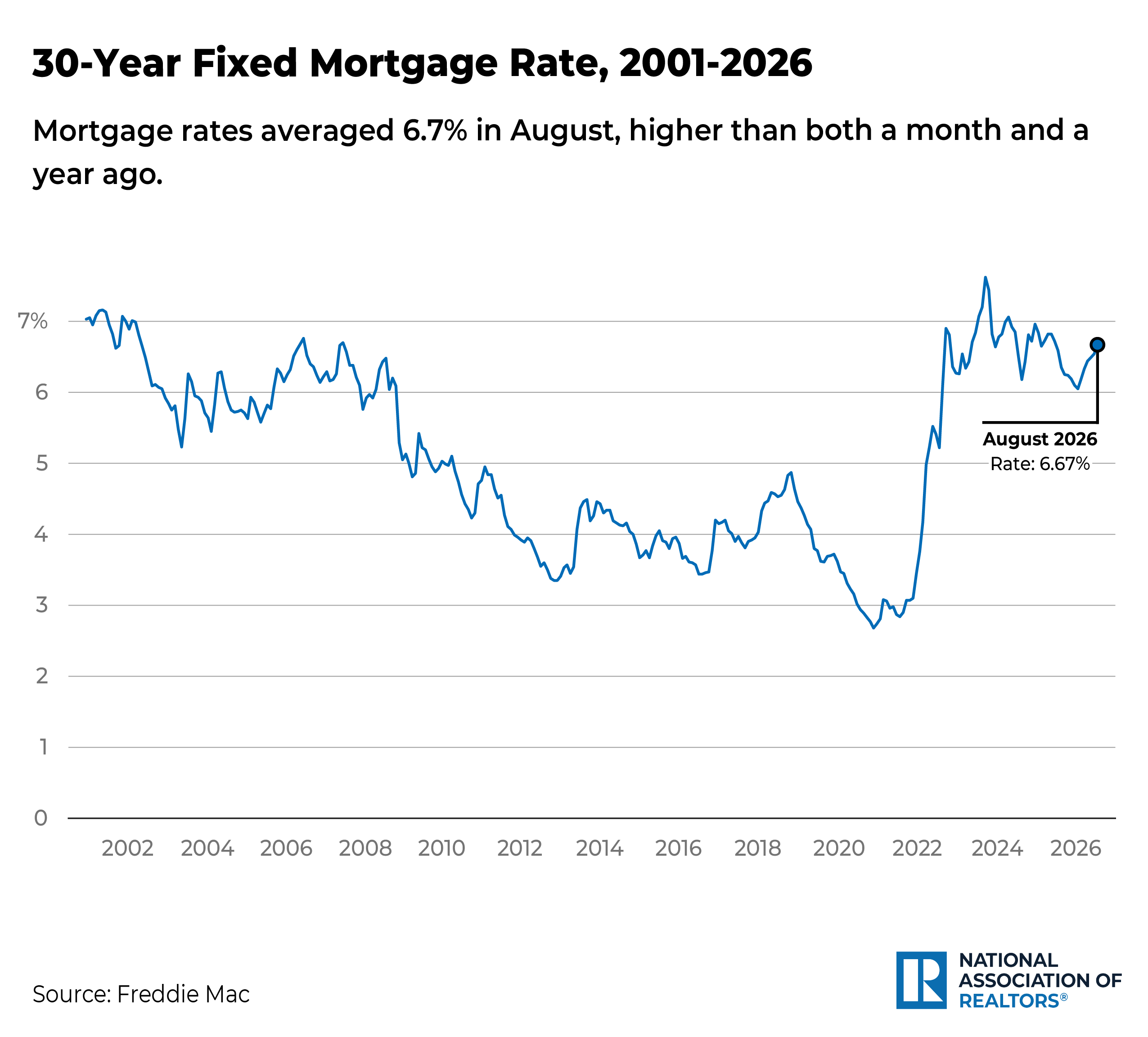
As rates started to climb last week, mortgage applications for home purchases—a weekly gauge of buyer interest—fell 19% from the same week a year ago, the Mortgage Bankers Association reports.
Real estate agents are seeing mixed reactions from buyers. Perna says some buyers are taking a wait-and-see approach. “It’s a 50-50,” he says. “I have some buyers saying, ‘Maybe we’ll just wait a couple of months. We’re going to wait for the rates to come down.’” Others, he says, are pushing ahead with their home purchases, recognizing that if rates dip, competition could surge again, and they could lose some of the negotiating power they’re currently seeing.
As some buyers wait for relief from elevated borrowing costs, they may have a longer wait. The Federal Reserve voted on Wednesday to raise its key benchmark interest rate by one quarter percentage point, its first rate hike in three years. The Fed does not directly set mortgage rates, but its decisions can influence financial markets and borrowing costs. Mortgage rates are more closely tied to long-term bond yields, including the 10-year Treasury, which recently climbed to its highest level in nearly two decades.
Yun says mortgage rates could remain elevated as inflation and other economic pressures persist. “Expect 7% as the new normal,” Yun says. He noted that mortgage rates could come down if oil prices retreat, inflation eases and a plan emerges to reduce the federal budget deficit.
Lisa Sturtevant, Bright MLS chief economist, also expects mortgage rates to remain “stuck at or above the 7% threshold, creating a psychological and financial barrier that will sharply squeeze affordability and sideline even more prospective buyers.”
Where Pending Home Sales Rose in August
Some markets are proving more resilient to higher borrowing costs than others. Among the 50 largest metro areas, the following markets posted the largest year-over-year gains in pending home sales from August, according to data from Realtor.com Economics:
- Richmond, Va.: +11.3%
- San Antonio-New Braunfels, Texas: +6.6%
- Memphis, Tenn.-Miss.-Ark.: +6.4%
- Virginia Beach-Chesapeake-Norfolk, Va.-N.C.: +5.1%
- Cincinnati, Ohio-Ky.-Ind.: +4.7%
- Austin-Round Rock-San Marcos, Texas: +4.2%
- Birmingham, Ala.: +4%
- Sacramento-Roseville-Folsom, Calif.: +1.7%
- Indianapolis-Carmel-Greenwood, Ind.: +0.9%
- St. Louis, Mo.-Ill.: +0.2%
