


Pending home sales rose last month, building on March’s modest gains and helping to reverse what had been a sluggish start to the spring housing market.
By even some economists’ accounts, the latest uptick in pending home sales—along with a recent rise in new home sales—may be coming as a surprise.
“Buyers are coming out with cautious optimism despite increasing economic uncertainty and a slight rise in mortgage rates,” says Lawrence Yun, chief economist at the National Association of REALTORS®.
NAR’s Pending Home Sales Index—a gauge of future home closings based on contract signings—rose 1.4% in April month over month and is 3.2% higher than levels from a year ago, the association reported Tuesday.
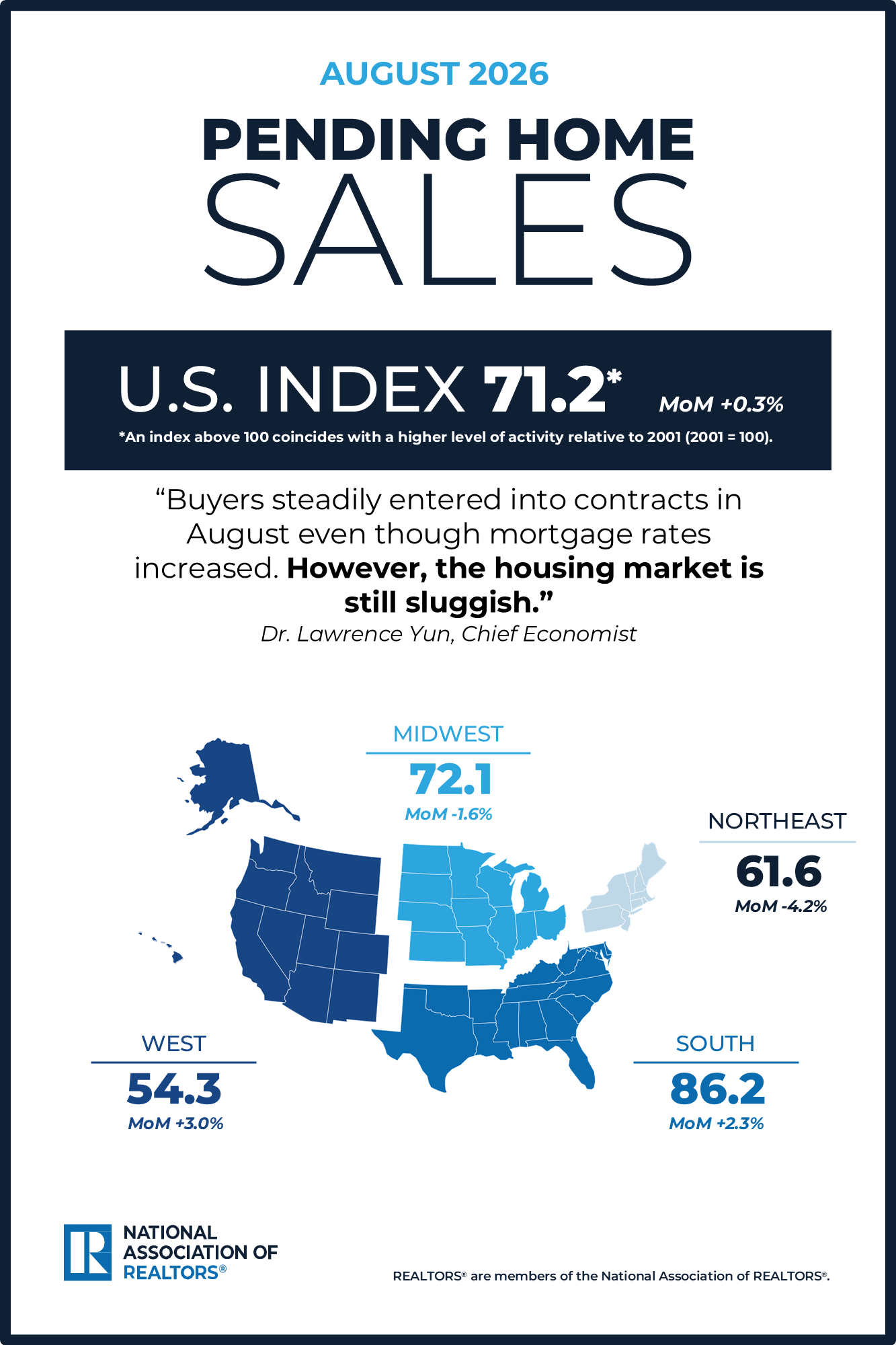
The Northeast region saw the largest increase in contract signings last month, with pending home sales climbing nearly 7% and led by a notable increase in the Boston area. The Midwest region followed with a 3% rise in contract signings, with places like Milwaukee and Columbus, Ohio, seeing some of the largest gains.
The recent rebound in contract signings follows another hopeful sign for the housing market: Sales of newly built single-family homes climbed 7.4% in March and are up 3.3% from a year ago.
10 Market Leaders With Pending Sales
Data from Realtor.com® Economics shows the following metros posted the largest year-over-year gains in April with pending home sales:
- Boston-Cambridge-Newton, Mass.-N.H.: +10.3%
- Miami-Fort Lauderdale-West Palm Beach, Fla.: +9.4%
- Oklahoma City, Okla.: +8.6%
- Milwaukee-Waukesha, Wis.: +7.4%
- Virginia Beach-Chesapeake-Norfolk, Va.-N.C.: +7.2%
- Raleigh-Cary, N.C.: +5.7%
- Dallas-Fort Worth-Arlington, Texas: +5.5%
- Washington-Arlington-Alexandria, D.C.-Va.-Md.-W.Va.: +5.4%
- Columbus, Ohio: +5.4%
- Charlotte-Concord-Gastonia, N.C.-S.C.: +5.1%
Home Prices, Buyer Demand Remain Resilient
Home price gains for existing-home sales are showing signs of slowing, up just 0.9% annually in April and dialing back from a much brisker pace of recent years. That moderation in home prices could come as a relief to home shoppers.
However, home prices overall remain strong: Seventy-one percent of 235 metro markets saw home prices rise during the first quarter of this year, with slightly more than a dozen of the markets even recording double-digit price gains, NAR reported earlier this month.
“Historically low foreclosure sales imply minimal price discounts, with a majority of markets selling at a higher price from a year ago,” Yun says. Distressed sales—which includes foreclosures and short sales—accounted for just 2% of sales in April, remaining at historical lows, NAR’s data shows.
Tight inventory continues to keep home prices on solid ground. “Multiple offers, though not as intense as a few years ago, are still occurring,” Yun recently noted. The latest REALTORS® Confidence Index showed homes listed in April received, on average, 2.5 offers.
“Unless supply meaningfully increases, home-price growth could outpace wage growth and further erode the homeownership rate,” Yun cautions. “All efforts need to be focused on boosting housing supply.”
Further, buyer demand “will easily be even higher once mortgage rates retreat to the levels they were at earlier this year,” Yun adds. Freddie Mac reports the 30-year fixed-rate averaged 6.36% last week. By comparison, rates dipped to 5.98% in late February, the lowest average in 3 1/2 years.
Even with mortgage rates moving higher in recent weeks, buyers are still showing up this spring: Data from the lockbox provider SentriLock shows home showings in April increased 8% compared to a year earlier, signaling buyers are continuing to re-engage with the housing market.
