


Resilient demand, new supply contraction and abundant acquisition capital are bolstering forecasts for modest growth in the multifamily sector for 2026, despite economic uncertainties, according to the Winter 2026 Yardi Matrix U.S. Multifamily Outlook report. Yardi forecasts a 1.2% increase in advertised rent growth nationally for 2026 and 2.0% for 2027, though projections vary by region. Rent growth should strengthen beginning in 2028.
Development activity is slowing nationwide. Yardi projects completions will drop 24% in 2026 to 450,000 deliveries, down from the 595,000 expected for 2025. Further slowing is projected in 2027 to 416,000, before increasing slightly to 421,000 in 2028.
Absorption Slowdown
Course correction is occurring after a period of oversupply. In its January 2026 Commercial Real Estate Insights Report, the National Association of REALTORS® reports absorption of 437,897 units in December 2025, a 19% decline from a year earlier. New deliveries of multifamily units dropped 26% over this same period and continued to exceed absorption rates. However, several regional bright spots appear.
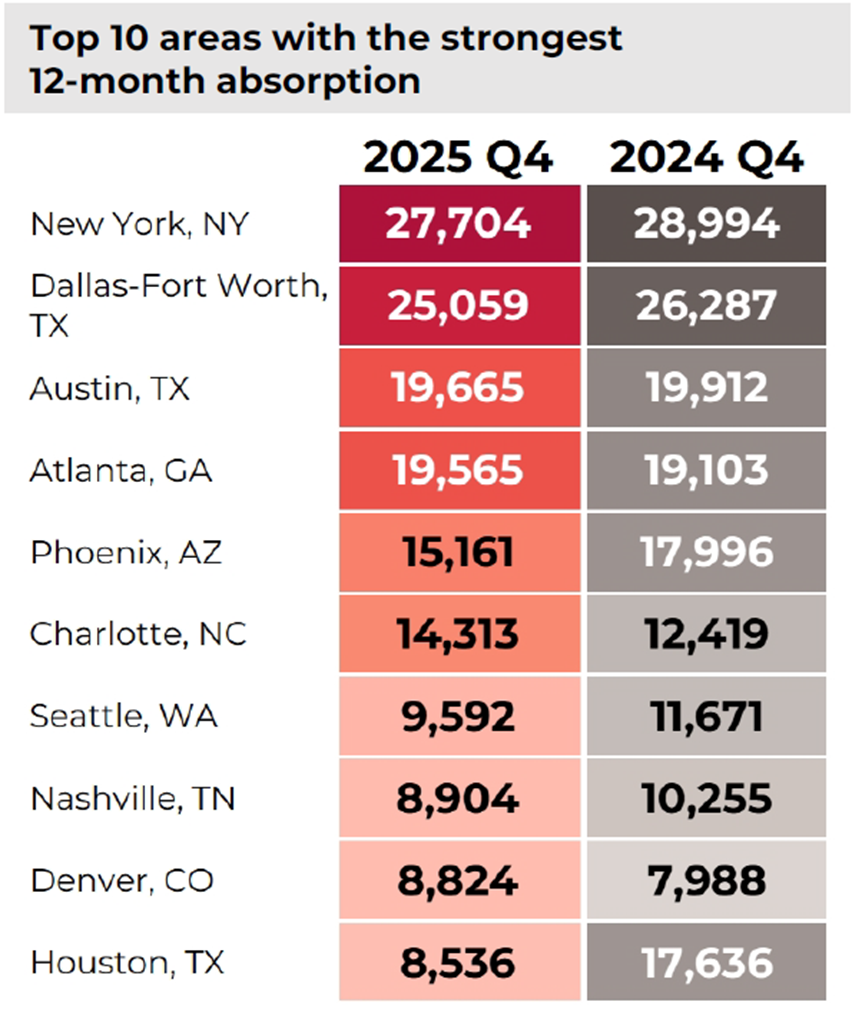
New York City topped NAR’s list of markets with the strongest 12-month absorption at 27,704, followed by Dallas-Fort Worth (25,059), Austin, Texas (19,665) and Atlanta (19,565). Rounding out the top ten were Phoenix; Charlotte, NC; Seattle; Nashville, Tenn.; Denver and Houston.
Market conditions were mixed across classes, with Class A showing stable but soft conditions, marked by a 0.1% rent decline, while vacancies held at 10.2%, NAR data shows. In the mid-tier segment, a rise in vacancies to 9.8% and a 0.1% drop in rent growth signaled a cooling momentum for Class B. Class C continues to outperform rent growth (up 1.1%) despite ongoing tenant turnover, with vacancies the lowest among the classes at 6.3%.
Rent Pressures
The volume of new deliveries has put pressure on rents, especially in the Sun Belt, where, since January 2023, Yardi reports the largest rent declines in recent years have been in Austin (-14.2%) and Phoenix (-9%). Alternatively, markets with limited new supply saw rent growth during the same period, with New York City (13.0%), Chicago (10.2%) and Kansas City (9.3%) topping its list.
Yardi expects regional trends to continue in 2026, with limited new construction and healthy absorption supporting rent growth in coastal and Midwest markets, led by Boston and Washington, D.C. (both at 2.1%), followed by Indianapolis and Kansas City (both at 1.9%) and Columbus and Detroit (both at 1.7%).
Sun Belt cities will continue to experience weak rent growth as they work through substantial lease-up pipelines, despite solid demand, Yardi reports.
Momentum in Capital Markets
After nearly two years of weak capital markets, equity and debt volumes rose throughout 2025 (up 7.2% in November compared with the previous year), Yardi's report says, and the momentum will likely continue, given declining interest rates, abundant acquisition capital and lenders eager to put money into the market.
Yet economic uncertainty and the widening gap in consumer wealth distribution between the top and bottom halves will continue to put pressure on the multifamily sector, which is sensitive to job growth and consumer confidence. Still, the overall stability of the multifamily sector is a positive counter during times of uncertainty.
