


The housing market is showing signs of improvement. Inventory has increased from recent lows, and affordability has modestly improved as mortgage rates have fallen to the low-6% range and incomes have continued to grow. Under normal market conditions, these developments would support a recovery in home sales.
However, transaction activity remains sluggish.
This report finds that the disconnect is driven by a dual constraint. The housing market continues to face an overall supply shortage, and the existing supply is not aligned with the price points buyers can afford. As a result, many of the homes currently on the market remain out of reach for a large share of potential buyers.
To better capture this dynamic, this report introduces the Listing–Income Alignment Score, which measures how well the distribution of listings matches the income distribution of households.
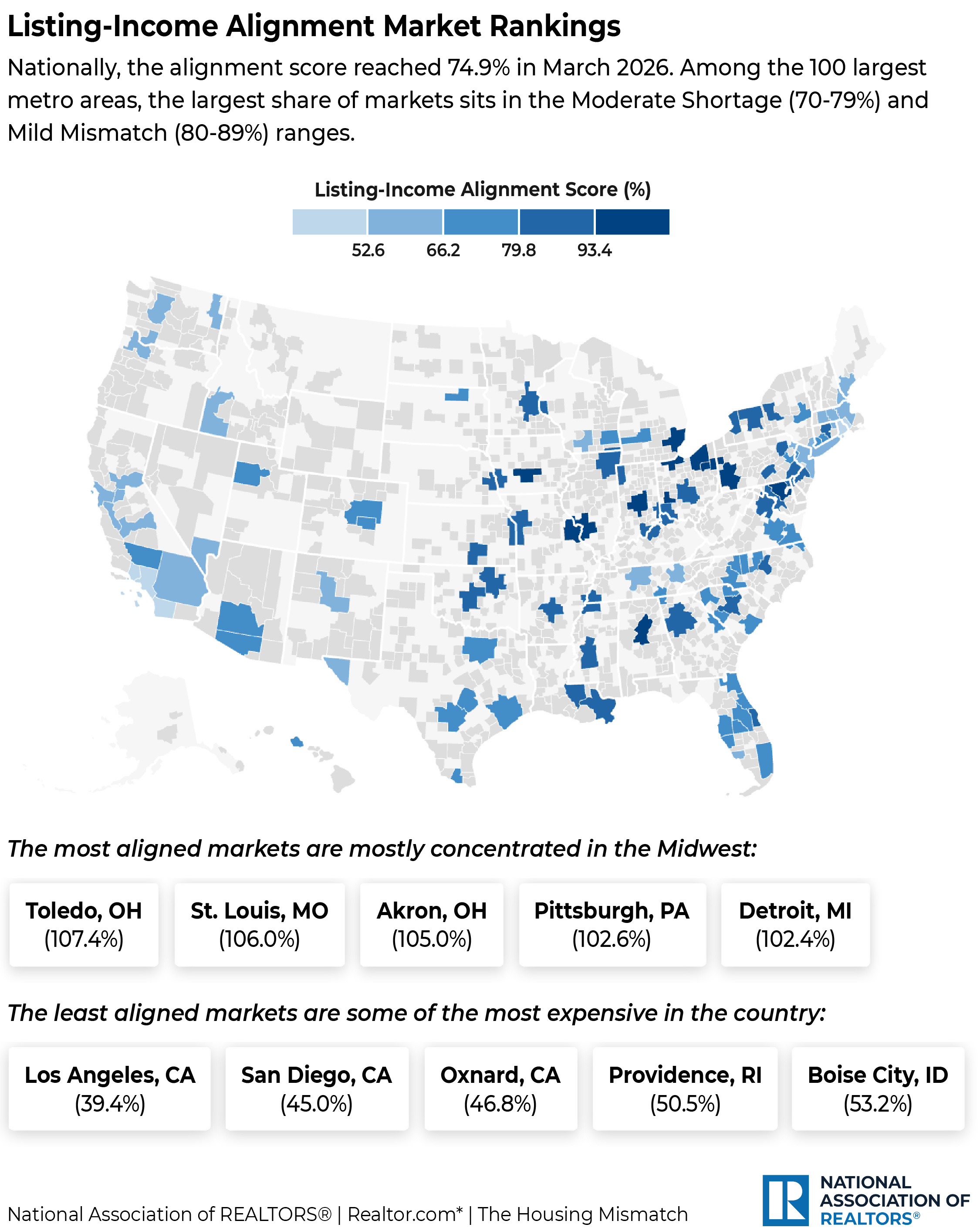
Across the country, the alignment score reached 74.9% in March 2026, up from 66.7% one year earlier, but still well below the pre-pandemic baseline of 84.4%. This means that, on average, households can access only about three-quarters of the housing opportunities they would have in a balanced market.
The mismatch is especially more severe in the middle of the market. In most markets, lower- and middle-income households face a shortage of listings within their price range, while listings at higher price points are relatively more abundant. This imbalance reduces the effective supply available to the buyers who typically drive transaction volume.
The result is a housing market that seems to be improving based on headline indicators, but continues to operate below its norm and potential. Rising inventory has not translated into stronger sales because a significant share of that inventory does not align with the financial capacity of today’s buyers, even before factors like mortgage rate lock-in are considered.
The key takeaway is that increasing supply alone will not be enough to restore normal market activity. A recovery will depend on both expanding overall inventory and improving the alignment between home prices and household incomes, especially in entry-level and middle-market segments.
Key Findings
- The national market offers buyers 75% of the access they would have in a balanced market - still 9.5 percentage points below pre-pandemic levels.
- Only 13% of metros have reached or exceeded the balanced-market benchmark (alignment score ≥ 90%). All are in the Midwest or Upper South.
- Thirty-six percent of metros fall below 70% alignment, which means that many lower- and middle-income households face a shortage of listings within their price range.
- Eleven percent of metros are in severe shortage (below 60%), including Los Angeles (39%), San Diego (45%), Oxnard (47%), Providence (51%), and Boise City (53%).
- Nineteen percent of metros have surpassed their 2019 alignment levels, led by Honolulu (+13.3 pp), Bridgeport (+10.7 pp), San Jose (+9.8 pp), Denver (+8.3 pp), and San Francisco (+8.3 pp).
- Many of the markets furthest below their 2019 levels are concentrated in the Northeast, even in the affordable areas: Allentown (-39.3 pp), Scranton (-31.6 pp), Springfield, MA (-28.8 pp), and Knoxville (-25.5 pp). However, this doesn’t mean these markets have the most severe shortages today. It’s just because of the very elevated scores before the pandemic.
- Madison, WI is the only metro among the 100 largest where alignment declined year-over-year (-7.7 pp), reversing the previous year’s improvement.
- In most markets, shortages are concentrated in the entry-level and middle segments of the market, while listings priced for upper-middle and high-income earners are in surplus. This is a structural mismatch that keeps transaction activity subdued even as headline inventory rises.
- Middle-income households continue to face the largest supply gap. Buyers earning around $75,000 can currently afford homes priced up to about $261,140. Homes priced below this point currently account for only about 23% of listings nationally, compared with about 44% in a balanced market. This represents an effective shortage of about 311,000 listings within reach of these buyers.