


Just as the housing market begins to offer buyers more opportunities—with growing inventory and more sellers cutting prices—rising mortgage rates are making some buyers nervous to move forward. Economists point to elevated borrowing costs as a key factor behind what is shaping up to be a sluggish fall homebuying season.
The National Association of REALTORS®’ newly released Pending Home Sales Index—a future gauge of home sales based on contract signings—fell 7.3% in September from August and was down 11.3% from a year ago. The latest home sales indicator follows September’s existing-home sales report—which tracks completed transactions—where sales squeezed out a 1.5% month-over-month gain but remained sluggish, with August and September posting the lowest sales levels of the year.
“Market conditions weakened in September due to fast-rising mortgage rates,” says Lawrence Yun, NAR’s chief economist. “Although job growth and income gains can support home purchases, housing affordability is more affected by changes in mortgage rates. … Buyers and sellers may simply be holding back until mortgage rates move favorably.”
The 30-year fixed-rate mortgage averaged 6.86% in September, but since October, rates have surpassed 7%. Freddie Mac reported 30-year rates averaged 7.4% for the week ending Oct. 15. On a $300,000, 30-year mortgage, a 7.4% rate translates to about $2,077 per month in principal and interest, compared with about $1,851 at the 6.27% average rate from a year ago—a difference of about $226 per month.
Related: Mortgage Rates Have Become the Housing Market’s Fall Nemesis
But the rapid run-up in mortgage rates over the last month may be nearing the end. “Given that mortgage rates have already risen much more than the Federal Reserve’s short-term interest rate hikes, mortgage rates could be topping out,” Yun says. “However, increasing energy prices and the resulting inflationary pressures are highly uncertain.”
Still, Yun said last week that he considers rates in the 7% range to be the new norm, at least for the foreseeable future. “I don’t see a major drop coming,” he said, pointing to current economic readings.
Strong Home Equity May Give Sellers More Flexibility
While prospective buyers may be feeling squeezed by affordability challenges, sellers may be in a stronger position because of the equity they’ve built—even as they begin making concessions.
NAR recently reported the median existing-home price reached $417,500 in September, up 1.3% from a year earlier and the highest September median on record.
Most homeowners retain substantial equity, and distressed sales remain rare. Foreclosures and short sales accounted for just 2% of existing-home sales in September, unchanged from a year earlier, according to NAR.
“Despite the difficult of obtaining a mortgage, the limited number of distressed properties is ensuring steady home prices,” Yun says.
That equity may give sellers more leeway to adjust their asking prices and negotiate with buyers. Signs of flexibility are emerging: Nearly 21% of active listings had price reductions in September, the highest share for that month since 2018, according to Realtor.com.
A Closer Look at Regional Trends
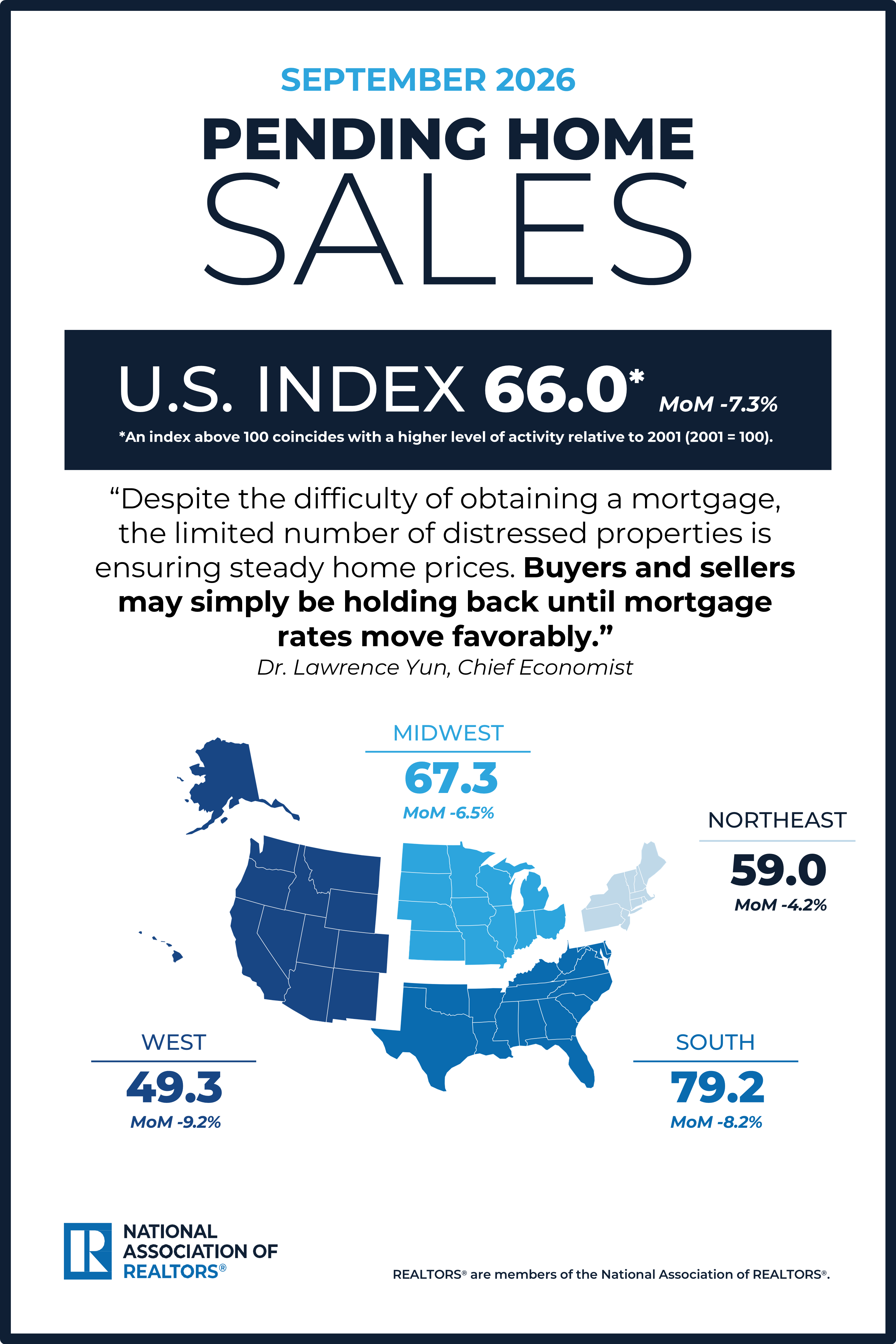
NAR’s Pending Home Sales Index showed each of the four major regions of the country saw fewer buyers go under contract last month. Still, housing market conditions vary significantly from one market to the next.
Contract signings in September dropped by the largest percentage in the West, falling 9.2% from August and down 15% from a year ago. The South followed with an 8.2% month-over-month and 12% annual decrease in September. The Midwest posted a 6.5% monthly decline and 8.7% decrease from a year ago.
Meanwhile, the Northeast fared best, but with pending home sales still falling 4.2% in September compared to August and down 9.4% from a year earlier. The region continues to grapple with some of the nation’s tightest housing inventories, which has fueled strong price gains and ongoing bidding wars in some markets. In September, the Northeast posted the largest annual home price increase in the country, with the median existing-home price rising 5% to $523,600.
Even in the strongest performing markets in September, pending home sales were down annually. Nevertheless, Realtor.com Economics reports the following 10 markets saw the smallest annual declines in pending home sales in September:
- Nashville-Davidson-Murfreesboro-Franklin, Tenn.: -2%
- Hartford-West Hartford-East Hartford, Conn.: -2.1%
- San Francisco-Oakland-Fremont, Calif.: -3.5%
- San Jose-Sunnyvale-Santa Clara, Calif.: -4.6%
- Buffalo-Cheektowaga, N.Y.: -5.6%
- Richmond, Va.: -5.8%
- Austin-Round Rock-San Marcos, Texas: -5.9%
- Pittsburgh, Pa.: -6.2%
- Memphis, Tenn.-Miss.-Ark.: -6.3%
- San Antonio-New Braunfels, Texas: -7.1%
